
Pogonocherus
Dejean, 1821
flat-faced longhorn beetles
Species Guides
6Pogonocherus is a of flat-faced longhorn beetles in the Cerambycidae, established by Dejean in 1821. in this genus are wood-boring cerambycids associated with coniferous , particularly pines. At least one species, P. perroudi, has been identified as a potential of pinewood (Bursaphelenchus xylophilus), the causal agent of . The genus contains approximately 30 described species distributed across the Northern Hemisphere.
Pronunciation
How to pronounce Pogonocherus: //ˌpɒɡəˈnɒkərəs//
These audio files are automatically generated. While they are not always 100% accurate, they are a good starting point.
Identification
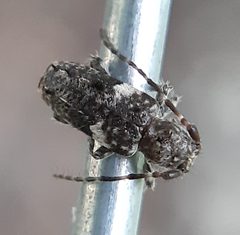
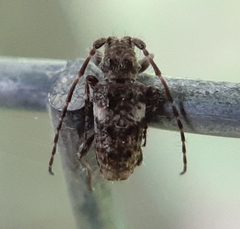
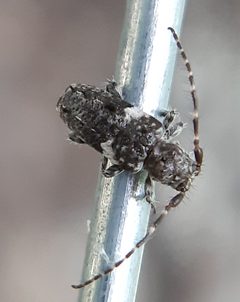
Pogonocherus are distinguished from other Lamiinae by their relatively small size, flattened facial profile (giving rise to the "flat-faced longhorn beetles"), and typically dull, pubescent or setose body surface. Species-level identification requires examination of antennal structure, pronotal , and elytral patterning. The can be separated from similar small lamiine genera by the combination of short , broad pronotum, and characteristic elytral patterns.
Images
Habitat
of Pogonocherus are found in coniferous and mixed forests, with documented associations with Pinus species. Field observations indicate occurrence in pinyon-juniper woodland and pine forest . Larval development occurs in dead or dying conifer wood.
Distribution
The has a trans-Palearctic and Nearctic distribution. Records exist from Europe (including Scandinavia), North Africa, and North America (United States and Canada). Specific distribution varies by , with some showing restricted regional ranges while others are more widespread.
Diet
Larvae are wood-borers, feeding on the inner bark and sapwood of dead or dying conifers. have been observed on tree trunks and branches, though specific adult feeding habits are poorly documented.
Host Associations
- Pinus edulis - larval Colorado pinyon pine; pupal chambers observed in dead branches
- Pinus pinaster - larval Maritime pine; colonized by P. perroudi in Portugal
- Pinus ponderosa - potential ponderosa pine; suitable dead wood stage inferred from congeneric
Life Cycle
Development proceeds through , larval, pupal, and stages. Larvae bore in dead or dying conifer wood, creating galleries in the inner bark and sapwood. occurs in pupal chambers constructed within the wood. Adults emerge through exit holes in the bark. One has been documented in pupal chambers within dead Pinus edulis branches, indicating a tied to recently dead material.
Behavior
are typically found on tree trunks and branches. Some are attracted to fermenting baits used in insect trapping studies. One species has been documented as a potential of pinewood , suggesting adult involves contact with nematode-infested wood prior to or during host .
Ecological Role
As wood-boring beetles, Pogonocherus contribute to nutrient cycling in coniferous forest by breaking down dead wood. At least one species (P. perroudi) has been identified as a potential of pinewood (Bursaphelenchus xylophilus), which causes . The cuticular chemistry of P. perroudi has been studied for its potential role in triggering nematode movement to vectors.
Human Relevance
Pogonocherus perroudi has been investigated as a potential of pinewood in Portugal, where it colonizes Pinus pinaster affected by . Research on cuticular compounds in this aims to develop management tools for pine wilt disease, including detection lures or repellents to disrupt nematode transmission cycles. The has no other documented economic significance.
Similar Taxa
- ArhopalusSimilar small to medium-sized lamiine beetles associated with conifers; differs in having more elongate body form and different antennal proportions
- MonochamusConifer-associated lamiine beetles that are also of pinewood ; Pogonocherus is distinguished by smaller size, flatter , and less robust build
- AcanthocinusSimilar small lamiines with pubescent bodies; differs in antennal length and pronotal structure
More Details
Cuticular Chemistry
Pogonocherus perroudi has been characterized for cuticular compounds alongside Monochamus galloprovincialis and Arhopalus syriacus. The shows a profile dominated by straight-chain hydrocarbons n-C27 (20-52%), n-C29 (4-18%), and 3-methyl-branched C27 (8-18%), grouping it more closely with M. galloprovincialis larvae than with A. syriacus in chemical .
Species Diversity
The contains approximately 30 described , including P. fasciculatus, P. hispidus, P. hispidulus, P. ovatus, P. perroudi, and P. propinquus. Several species have restricted distributions, such as P. arizonicus (southwestern United States) and P. creticus (Crete).