
Oberea tripunctata
(Swederus, 1787)
dogwood twig borer
Oberea tripunctata, commonly known as the dogwood , is a of longhorn beetle in the Cerambycidae. emerge in early June and feed on dogwood twigs, causing girdling damage. Females lay singly on healthy twigs; larvae bore into twigs and overwinter in stems, with some individuals taking up to two years to complete development. The species is considered a minor pest of flowering dogwood and has been recorded from additional including elm, azalea, viburnum, and various fruit trees.
Pronunciation
How to pronounce Oberea tripunctata: /oʊˈbɪə.rə traɪˌpʌŋkˈtɑːtə/
These audio files are automatically generated. While they are not always 100% accurate, they are a good starting point.
Identification
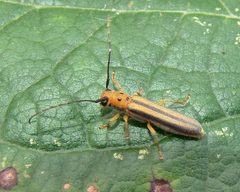
are slender and elongated, measuring 10–15 mm in length and approximately 3 mm in width. The is dark to black. The bears three prominent black spots arranged in a triangular pattern. The are yellowish tan with a narrow black line on the inner edge and a broader dark line on the outer lateral margin; two distinct dots are present immediately behind the head. Final-instar larvae are yellowish, legless, and approximately 19 mm long.
Images
Habitat
Associated with flowering dogwood trees (Cornus florida); also found on elm, azalea, viburnum, and various fruit trees. Occurs in wooded areas, suburban landscapes, and wherever plants are present.
Distribution
Widespread in the United States; present in Canada in Alberta, Manitoba, New Brunswick, and Ontario.
Seasonality
emerge in early June. Larvae overwinter in stems and pupate in spring, with typically occurring between mid-May and early June.
Diet
feed on dogwood twigs. Larvae bore into twigs and feed internally on woody tissue. Primary is flowering dogwood (Cornus florida); additional hosts include elm (Ulmus), azalea (Rhododendron), viburnum, and various fruit trees.
Host Associations
- Cornus florida - primary flowering dogwood; primary for feeding and oviposition
- Ulmus - elm
- Rhododendron - azalea
- Viburnum - viburnum
- various fruit trees - unspecified fruit tree
Life Cycle
Females lay singly on healthy twigs. Upon hatching, larvae enter twigs and bore downward into the center, creating closely packed holes to expel . Larvae overwinter within stems. Some larvae require two years to complete development. occurs in spring, with emerging between mid-May and early June.
Behavior
cause girdling damage around twig tips while feeding. Larvae bore internally through twig tissue, sometimes internally separating portions of twigs.
Human Relevance
Considered a minor pest of dogwood. is indicated by wilting leaves on twigs, drooping, and girdling of twig tips. Control methods include pruning infested twigs several inches below the girdle and destroying them before in spring, or applying before plant . Less damaging than the dogwood borer (Synanthedon scitula).
Similar Taxa
- Oberea oculaticollisSimilar slender body form and grayish ; distinguished by dark and dense gray pubescence in O. oculaticollis versus yellowish tan with black markings in O. tripunctata
- Synanthedon scitulaBoth attack dogwood; S. scitula (dogwood borer) is a clearwing moth (Sesiidae) and causes more severe damage; differ markedly in appearance
Sources and further reading
- BugGuide
- Wikipedia
- GBIF taxonomy match
- iNaturalist taxon
- NCBI Taxonomy
- Catalogue of Life
- Amazing Story About What Entomologist Lynn Kimsey Recorded in San Francisco Bay 50 Years Ago | Bug Squad
- The one that got away! | Beetles In The Bush
- Beautiful box of Buprestidae | Beetles In The Bush
- Life History of Oberea Tripunctata Swed.