
Hyperplatys aspersa
(Say, 1824)
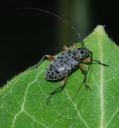
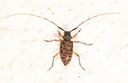
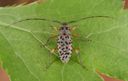
Hyperplatys aspersa is a small greyish longhorn beetle in the Lamiinae, described by Thomas Say in 1824. It is one of two Hyperplatys occurring in Eastern Canada, alongside H. maculata. The species has a history of taxonomic confusion, having been frequently misidentified by early authors.
Pronunciation
How to pronounce Hyperplatys aspersa: //haɪ.pəˈpleɪ.tɪs æsˈpɜːr.sə//
These audio files are automatically generated. While they are not always 100% accurate, they are a good starting point.
Identification
Distinguished from the sympatric H. maculata by specific elytral spot patterns and genitalic characters; microscopic examination often required for definitive identification. Historical misidentifications are common in literature, with Craighead's 1923 larval and pupal description of 'H. asperus' actually referring to H. maculata rather than H. aspersa.
Images
Appearance
Small greyish long-horned beetle with spotted . elongated, characteristic of Cerambycidae.
Habitat
Associated with deciduous woodlands; larvae develop in dead branches of hardwood trees. Red buckeye (Aesculus pavia) recorded as a larval in the Ozark Highlands.
Distribution
North America: recorded from Alberta, British Columbia, Manitoba, and New Brunswick in Canada; present throughout the United States. Eastern Canada represents part of its core range.
Host Associations
- Aesculus pavia - larval Dead branches utilized for larval development; new record established in Ozark Highlands
Life Cycle
Complete with , larva, pupa, and stages. Larvae are wood-borers in dead hardwood branches. stages described in scientific literature, though early descriptions mixed with H. maculata.
Behavior
likely active on vegetation. Larvae bore in dead wood, requiring decaying hardwood branches for development.
Ecological Role
Decomposer; larvae contribute to nutrient cycling by breaking down dead hardwood branches. Saproxylic dependent on decaying wood resources.
Similar Taxa
- Hyperplatys maculataSympatric in Eastern Canada; similar size, coloration, and spotted pattern. Frequently historically confused with H. aspersa; requires careful examination to distinguish.
Misconceptions
Historically misidentified in multiple authoritative works including Blatchley (1910), Felt (1924), and Knull (1946). Craighead's 1923 description of 'H. asperus' pupa actually refers to H. maculata, not H. aspersa.
More Details
Taxonomic history
Subject to considerable nomenclatural instability; basionym Hyperplatys aspera, with subsequent variations including H. aspersus. Current accepted spelling is H. aspersa.