
Hyperplatys
Haldeman, 1847
Species Guides
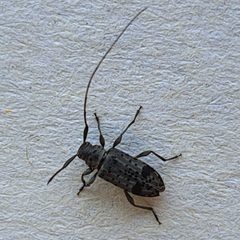
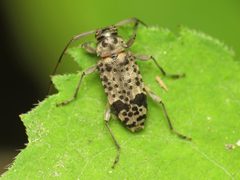
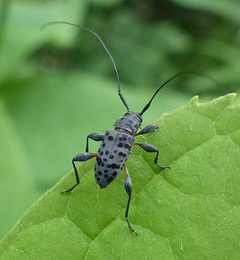
4Hyperplatys is a of small longhorn beetles in the Lamiinae, established by Haldeman in 1847. are characterized by greyish bodies with spotted . The genus has experienced substantial historical taxonomic confusion, with multiple species misidentified by early authors. At least 11 species are recognized, distributed primarily in North America. Two species, H. maculata and H. aspersa, occur in Eastern Canada.
Pronunciation
How to pronounce Hyperplatys: /haɪpərˈplætɪs/
These audio files are automatically generated. While they are not always 100% accurate, they are a good starting point.
Identification
Members of Hyperplatys are small, greyish longhorn beetles with spotted . The has suffered from considerable taxonomic confusion with related ; historical misdeterminations by Blatchley (1910), Felt (1924), and Knull (1946) suggest careful examination is required for accurate identification. H. maculata and H. aspersa in particular have been frequently confused.
Images
Habitat
H. maculata has been reared from dead branches of red buckeye (Aesculus pavia) in rich, moist, east-facing slopes of the Ozark Highlands.
Distribution
North America. Eastern Canada (Vermont, and provinces with H. maculata and H. aspersa). Additional records from the Ozark Highlands of Missouri.
Seasonality
likely active in spring; H. maculata was reared from wood collected in spring following seasonal cutting of branches left in situ for one season.
Host Associations
- Aesculus pavia - larval dead branches; new larval record established by MacRae and Rice 2007
Life Cycle
Complete with wood-boring larval stage. Larvae develop in dead branches. Craighead (1923) described larva and pupa, though his pupal description apparently refers to H. maculata rather than H. aspersa as originally labeled.
Behavior
Larvae are wood-borers in dead branches of hardwood trees. have been encountered in early spring in association with blooming red buckeye.
Ecological Role
Decomposer; contributes to breakdown of dead woody material in forest .
Similar Taxa
- Astyleiopus variegatusco-occurs as wood-boring cerambycid in same material; both reared from dead red buckeye branches
- Leptostylus transversussympatric lamiine cerambycid with similar ; co-reared from same substrate
- Lepturges angulatussympatric cerambycid reared from same material
Misconceptions
Historical literature contains numerous misdeterminations of Hyperplatys . Craighead's (1923) description of the pupa of 'H. asperus' actually refers to H. maculata, indicating long-standing confusion between these two species.
More Details
Taxonomic history
The was established by Haldeman in 1847 with H. femoralis as type . Multiple species were described by Bates in the 1860s–1880s from Central and South American material.
Research significance
MacRae and Rice (2007) established new larval records for five cerambycid including H. maculata, documenting that red buckeye serves as a previously unrecognized host plant in the Ozark Highlands.