
Leptostylus transversus
(Gyllenhal, 1817)
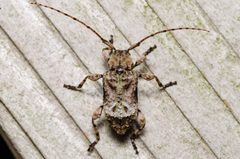
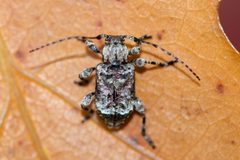
Leptostylus transversus is a flat-faced longhorn in the Lamiinae, tribe Acanthocinini. It is among the most common longhorned beetles in Missouri, with 268 specimens examined in a statewide study. The exhibits a strongly bimodal seasonal occurrence pattern, with active primarily in spring (March–June) and fall (September–October), with very few records from mid-summer. Adults are extremely , utilizing both angiosperms and gymnosperms without preference, including serviceberry, hickory, persimmon, eastern red-cedar, and multiple pine species.
Pronunciation
How to pronounce Leptostylus transversus: /lɛptoʊˈstaɪləs trænsˈvɜrsəs/
These audio files are automatically generated. While they are not always 100% accurate, they are a good starting point.
Identification
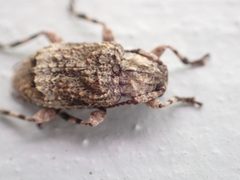
A member of the flat-faced longhorn Lamiinae, distinguished by the orthognathous (vertical) with mouthparts directed downward rather than forward as in other cerambycine longhorns. Like other Acanthocinini, exhibits mottled bark-like coloration with and erect setae creating a warty, cryptic appearance. The combination of flattened face and rough, bark-mimicking texture separates it from similar-sized cerambycine longhorns.
Images
Habitat
Dead wood of various tree ; collected from dead branches in forested areas. plants include both hardwoods and conifers across diverse forest types.
Distribution
North America. Recorded from Canada (Ontario, Québec) and throughout the United States. In Missouri, found statewide.
Seasonality
Bimodal activity: March through June and September through October, with almost no records from July or August. This pattern suggests adults emerge in late summer and fall, overwinter, and become active again the following spring.
Diet
Extreme polyphagy with no preference between angiosperms and gymnosperms. Larvae develop in dead wood of: Amelanchier arborea (serviceberry), Carya ovata (shagbark hickory), Diospyros virginiana (persimmon), Juniperus virginiana (eastern red-cedar), Pinus echinata (shortleaf pine), and Pinus sylvestris (Scots pine).
Life Cycle
Larvae develop in dead branches of trees. emerge primarily after mid-August based on reared specimens. Adults overwinter and resume activity the following spring, accounting for the bimodal seasonal pattern.
Ecological Role
Wood decomposer; larvae tunnel in dead branches, contributing to nutrient cycling. Serves as prey for predatory beetles including checkered beetles (Cleridae).
Human Relevance
Documented new larval record from red buckeye (Aesculus pavia), a plant whose natural distribution in Missouri was previously poorly known.