
Astylopsis macula
(Say, 1826)
Spotted Long-horned Beetle
Astylopsis macula is a of longhorn beetle in the Lamiinae, described by Thomas Say in 1826. Commonly known as the Spotted Long-horned , it belongs to the tribe Acanthocinini within the Cerambycidae. The species has been documented across eastern North America with over 500 observations recorded.
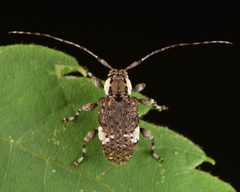
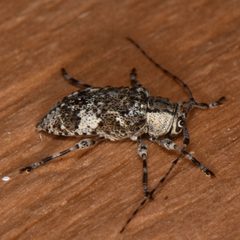
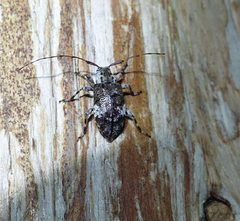
Pronunciation
How to pronounce Astylopsis macula: /əˈstaɪlɒpsɪs ˈmækjʊlə/
These audio files are automatically generated. While they are not always 100% accurate, they are a good starting point.
Images
Distribution
Eastern North America. Documented presence in Canada (New Brunswick, Nova Scotia, Ontario, Québec) and the United States. GBIF records confirm North American distribution.
Host Associations
- Pinus - larval developmentLarvae have been found in dead shortleaf pine (Pinus echinata) stems, suggesting pine serve as larval . Observed in dry-mesic oak/pine forest .
Similar Taxa
- Astylopsis sexguttataBoth are pine-associated members of tribe Acanthocinini with similar larval habits in dead pine stems. A. sexguttata is distinguished by six-spotted patterning versus the spotted pattern implied by A. macula's epithet.
More Details
Original Description
First described by Thomas Say in 1826 as Amniscus macula, later transferred to Astylopsis. The original description date is sometimes cited as 1827 in secondary sources.
Taxonomic Placement
Member of tribe Acanthocinini, a diverse group of longhorn beetles commonly associated with coniferous and hardwood trees. Many Acanthocinini develop in dead or dying wood.
Sources and further reading
- BugGuide
- Wikipedia
- GBIF taxonomy match
- iNaturalist taxon
- NCBI Taxonomy
- Catalogue of Life
- Be careful around baldfaced hornets, Dolichovespula maculata — Bug of the Week
- An inside look at baldfaced hornets, Dolichovespula maculata — Bug of the Week
- Paper nests here and there: Baldfaced hornets, Dolichovespula maculata, and tropical nest builders, Polybia spp. — Bug of the Week
- High fiber diets for baldfaced hornets? Nah, construction materials for enlarging nests: Baldfaced hornets, Dolichovespula maculata — Bug of the Week
- What do insects do in winter, Part 2? Tolerating the big chill: Banded woolly bears, Pyrrharctia isabella, field crickets, Gryllus spp., baldfaced hornets, Dolichovespula maculata, and others — Bug of the Week
- Alydidae | Beetles In The Bush