
Elytrimitatrix undata
(Fabricius, 1775)
Wavy Longhorn Beetle
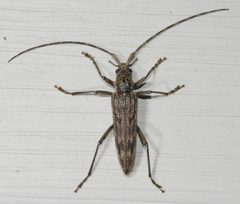
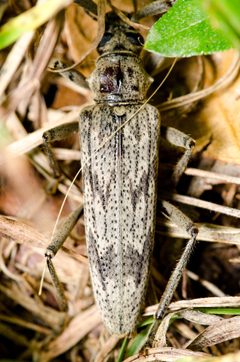
Elytrimitatrix undata is the only member of the Disteniinae (or Disteniidae) occurring in the United States. This longhorned beetle was formerly classified in the Distenia but was split out by Santos-Silva & Hovore in 2007 based on morphological differences. The occurs broadly across eastern and central North America and is regularly attracted to lights during warm summer nights. are moderate-sized beetles with distinctive wavy elytral patterns.
Pronunciation
How to pronounce Elytrimitatrix undata: //ˌɛl.ɪ.trɪˈmɪt.ə.trɪks ʌnˈdeɪ.tə//
These audio files are automatically generated. While they are not always 100% accurate, they are a good starting point.
Identification
Distinguished from other North American longhorned beetles by its placement in the Disteniinae, which has been variously treated as a tribe of Lepturinae, a tribe of Cerambycinae, or a separate . The wavy elytral patterns are distinctive. Formerly classified as Distenia undata, it is now the sole U.S. representative of the Elytrimitatrix. Superficially resembles other cerambycids but with subtle morphological differences in wing venation and other characters that have led to its separate subfamilial status.
Images
Appearance
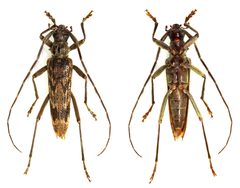
Moderate-sized longhorned beetle with distinctive wavy or undulating patterns on the , from which the epithet derives. Body form is typical of cerambycids with long . Coloration is somewhat muted compared to more brightly colored relatives.
Habitat
Mesic lowland deciduous forests. have been observed nocturnally on the trunks of large standing oak trees (Quercus spp.).
Distribution
Broadly distributed across eastern and central United States. Records from Missouri, Arkansas, and throughout the eastern and central states. The only member of its occurring in the U.S.
Seasonality
Active during warm, muggy summer months. are regular visitors at lights from July through August. One record from mid-July in Missouri.
Host Associations
- Quercus - observed on trunklarge standing oak tree at night
- various hardwoods - larval larvae recorded breeding in dead wood
- Pinus - larval larval , including pine
Life Cycle
Larvae develop in dead wood of various hardwoods and pine, mining beneath the bark rather than in the wood itself. emerge during summer.
Behavior
Nocturnally active on tree trunks. Regularly attracted to ultraviolet and mercury-vapor lights during summer nights. have been observed in numbers at fermenting liquid traps (molasses, beer, water, yeast mixture).
Ecological Role
Wood-boring contributing to decomposition of dead and dying trees. Larval development in dead wood aids in nutrient cycling and forest processes.
Human Relevance
Collected by entomologists for scientific study. Occasionally encountered at porch lights by homeowners. No known economic importance as a pest.
Similar Taxa
- other CerambycidaeSuperficially resembles other longhorned beetles but distinguished by subfamilial characters and wavy elytral patterns
- former Distenia speciesPreviously classified in Distenia but separated based on morphological differences in wing venation and other characters
More Details
Taxonomic History
The Disteniinae has long been controversial, treated variously as a tribe of Lepturinae, a tribe of Cerambycinae, a subfamily of Cerambycidae, or even a separate (Disteniidae). Current consensus places it as a distinct subfamily within Cerambycidae, though exact relationships remain unclear. The was transferred from Distenia to Elytrimitatrix by Santos-Silva & Hovore (2007).
Collection Methods
are readily collected using ultraviolet or mercury-vapor lights during warm summer nights. Fermenting liquid traps (1 part molasses, 1 part beer, 8 parts water, and dry yeast) have also proven effective for collecting this in numbers.