
Disteniinae
disteniid longhorn beetles
Genus Guides
1Disteniinae is a of longhorn beetles (Cerambycidae) comprising approximately 400 described , primarily distributed in tropical and subtropical regions of the Americas. are characterized by their elongated, slender bodies, long that often exceed body length, and frequently metallic coloration. The group has undergone significant taxonomic revision, having been treated historically as a tribe within Lepturinae or Cerambycinae, as a separate subfamily, and even as a distinct (Disteniidae) before current consensus places it as a subfamily within Cerambycidae. The North American fauna is depauperate, with Elytrimitatrix undata being the sole representative in the United States.
Pronunciation
How to pronounce Disteniinae: //dɪˈstiːni.aɪni//
These audio files are automatically generated. While they are not always 100% accurate, they are a good starting point.
Identification
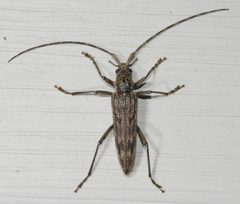
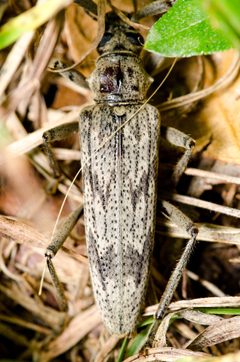
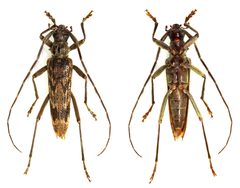
Disteniinae can be distinguished from other cerambycid by the combination of: extremely long, thread-like () that are typically longer than the body; elongated, parallel-sided body form resembling certain Lepturinae; often metallic green, blue, or bronze coloration; and wing venation patterns that differ from other cerambycids, with reduced anal . The pronotum is typically narrower than the base. Elytrimitatrix undata, the only U.S. , has a distinctive undulate (wavy) pattern on the elytra and lacks the triangular scutellum characteristic of some related groups.
Images
Habitat
are found in forested , particularly in mature hardwood forests and pine woodlands. Larvae develop in dead wood of various hardwoods and conifers, typically in larger diameter branches and trunks rather than small twigs. The group shows preference for dead or dying trees and freshly cut timber.
Distribution
The is predominantly Neotropical, with greatest diversity in Central and South America. In the United States, Elytrimitatrix undata occurs broadly across the eastern and central states, ranging from the Atlantic coast west to the Great Plains and from the Gulf Coast north to the Great Lakes region. The is absent from the western United States and most of Canada.
Seasonality
are active during the warm months, typically from late May through August in temperate regions. Peak activity occurs during June and July. Adults are and frequently attracted to artificial light sources.
Diet
Larvae are wood-borers that feed on dead or dying wood of hardwood trees and pines. Specific associations include oak (Quercus), hickory (Carya), sugarberry (Celtis laevigata), and various pine (Pinus). The breadth of host utilization varies among species, with some showing relative host specificity while others are .
Life Cycle
Complete with , larval, pupal, and stages. Larvae bore into dead wood, creating galleries in the phloem and outer sapwood. Development likely spans one to two years depending on climate and condition. occurs within the wood, and adults emerge through exit holes. Adults are relatively short-lived and do not feed extensively on woody material, though they may take nectar or other fluids.
Behavior
are primarily and strongly attracted to ultraviolet light sources. They are also captured in fermenting traps, suggesting attraction to yeasty or alcoholic volatiles. Adults are relatively inactive during daylight hours and seek sheltered resting sites on tree trunks. When disturbed, they exhibit rapid, erratic movement.
Ecological Role
As primary decomposers of dead wood, larvae contribute to nutrient cycling and carbon release in forest . Their tunneling activity creates for other saproxylic organisms and accelerates wood decay. may serve as or prey for various , though specific ecological interactions remain poorly documented.
Human Relevance
Limited direct economic importance. Not considered significant forest pests as larvae primarily colonize already dead or dying trees rather than attacking healthy timber. Occasionally encountered by entomologists and naturalists at light traps. The group has been subject to taxonomic debate regarding its familial versus subfamilial status, with implications for phylogenetic studies of Chrysomeloidea.
Similar Taxa
- LepturinaeSimilar elongated body form and long ; distinguished by differences in wing venation, tarsal structure, and typically more robust pronotum in Lepturinae
- Cerambycinae: Stenocorus and alliesSuperficially similar slender build and long ; separated by antennal insertion details, wing venation patterns, and larval