
Smodicum cucujiforme
(Say, 1826)
Flat Oak Borer
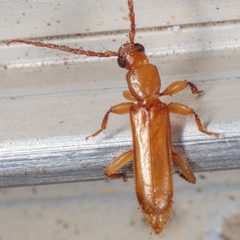
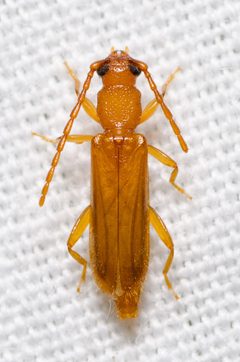
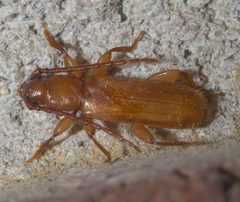
Smodicum cucujiforme, commonly known as the Flat Oak Borer, is a of longhorn beetle in the Cerambycidae. It was first described by Thomas Say in 1826, originally placed in the Callidium. The species is known from North and South America, with records from the United States, Canada (Ontario), and Argentina. It is attracted to ultraviolet and mercury-vapor lights, and has been captured in baited jug traps using ethanol and wine mixtures.
Pronunciation
How to pronounce Smodicum cucujiforme: /ˈsmoːdɪkʊm kʊˌkuːdʒɪˈfɔrmeɪ/
These audio files are automatically generated. While they are not always 100% accurate, they are a good starting point.
Identification
Smodicum cucujiforme can be distinguished from similar longhorn beetles by its flattened, cucujiform (flattened and parallel-sided) body shape, which is reflected in both its epithet and . Members of the Smodicum are characterized by their dorsoventrally compressed bodies, distinguishing them from the more cylindrical forms typical of many cerambycids. The species lacks the prominent antennal features seen in related genera.
Images
Habitat
Associated with riparian deciduous woodlands and canyon . Has been collected in hackberry/soapberry woodland canyons and areas with black willow (Salix nigra). The appears to utilize hardwood trees, particularly oaks (Quercus spp.), as suggested by its .
Distribution
North America: United States (including Oklahoma, Missouri, and widely across the continent), Canada (Ontario); South America: Argentina. GBIF records indicate presence in both continents with specific localities including Arkansas (AR) in the United States and Ontario in Canada.
Seasonality
activity has been documented in July in Oklahoma. The is attracted to lights at night during summer months.
Host Associations
- Quercus - larval Implied by 'Flat Oak Borer'; specific oak not documented in sources
Behavior
, attracted to artificial light sources including ultraviolet and mercury-vapor lights. have been captured at light setups in canyon riparian woodlands during evening collecting sessions.
Similar Taxa
More Details
Collecting Methods
The has been successfully captured using jug traps baited with ethanol, sweet red wine, or 50:50 mixtures of both. These traps use propylene glycol or ethylene glycol as killing agents and preservatives. The species is also readily collected at ultraviolet and mercury-vapor light setups.