
Smodicini
Genus Guides
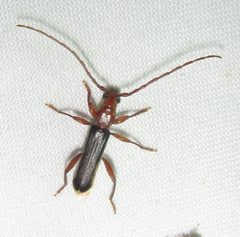
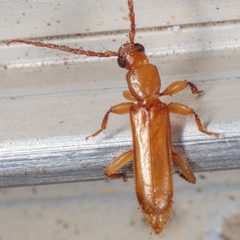
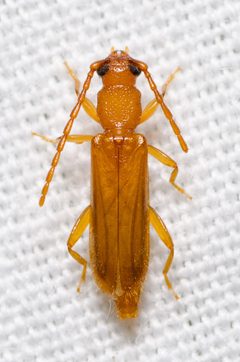
1Smodicini is a tribe of longhorn beetles within the Cerambycinae, Cerambycidae. The tribe comprises approximately 10 distributed across multiple continents, with the genus Smodicum being the most -rich. Members are small to medium-sized cerambycids with somewhat flattened bodies. Many species exhibit cucujiform (flattened, elongate) body shapes reminiscent of cucujid beetles, a trait reflected in species epithets such as Smodicum cucujiforme.
Pronunciation
How to pronounce Smodicini: /ˌsmoʊdɪˈsaɪnaɪ/
These audio files are automatically generated. While they are not always 100% accurate, they are a good starting point.
Identification
Smodicini can be distinguished from other Cerambycinae tribes by the combination of: body somewhat flattened and often elongate; antennal widely separated; procoxal cavities open posteriorly; and pseudotetramerous with the fourth tarsomere small and concealed between the lobes of the third. The cucujiform (flattened, parallel-sided) body shape in many provides a useful visual cue, though this is not universal across all . The tribe lacks the strongly developed lateral pronotal carinae found in some related groups.
Images
Habitat
Specific associations are poorly documented for most Smodicini. Available records suggest occurrence in forested and woodland environments. Larval development likely occurs in dead or decaying wood, consistent with the -wide of Cerambycidae, though direct observations are limited.
Distribution
The tribe has a disjunct distribution spanning multiple biogeographic regions. occur in: Africa (Afrosmodicum, Caediscum), Madagascar (Holorusius, Nesosmodicum), South America (Marupiara, Metaphrenon, Morettus, Pseudossibia), and North America including the southwestern United States, Mexico, and Central America (Luscosmodicum, Smodicum). The genus Smodicum shows the widest range, extending from eastern North America through Mexico to South America.
Similar Taxa
- Other Cerambycinae tribesSmodicini may be confused with tribes such as Callichromini or Graciliini due to general body form, but differs in antennal separation, tarsal structure, and pronotal characteristics. The cucujiform resemble actual cucujid beetles ( Cucujidae), representing likely mimicry or convergent to similar microhabitats under bark.
More Details
Taxonomic History
The tribe was established by Thomson in 1864. The type Smodicum was described by Haldeman in 1847 based on North American material. Several genera were added during the 20th century, with significant revisions by Martins (1970, 1975) and Martins & Galileo (2006) expanding the tribe's known diversity, particularly in the Neotropics.
Larval Biology
Larval stages remain poorly known across most . The few documented rearing records for Smodicum indicate development in dead hardwoods, with larvae creating galleries in seasoned or decaying wood rather than living trees.