
Rhopalophora angustata
Schaeffer, 1905
Narrow-necked Rhopalophora
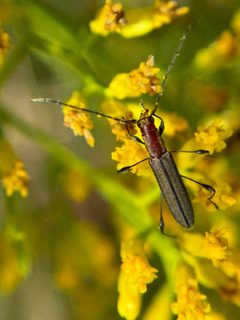
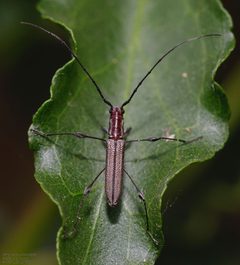
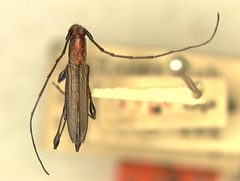
Rhopalophora angustata is a of longhorned beetle in the Cerambycidae, described by Schaeffer in 1905. It belongs to the tribe Rhopalophorini, a group of slender, beetles frequently found on flowers and exhibiting group mimicry resembling small . The species occurs in southwestern North America and Mexico.
Pronunciation
How to pronounce Rhopalophora angustata: /ˌroʊpəˈlɒfərə æŋˈɡʌstə/
These audio files are automatically generated. While they are not always 100% accurate, they are a good starting point.
Identification
Members of the tribe Rhopalophorini, including R. angustata, are characterized by slender body form, black coloration with red and/or pronotum, and distinctly (club-shaped) legs. The specific epithet "angustata" (meaning narrowed) likely refers to the constricted or narrow neck region. Close examination of antennal segment proportions and pronotal shape may be necessary to distinguish this from .
Images
Habitat
Associated with flowering vegetation in arid and semi-arid regions; related have been collected on milkweed (Asclepias spp.) and Ceanothus flowers.
Distribution
Southwestern United States (Arizona and adjacent areas) and Mexico. Distribution records indicate presence in Middle America and North America.
Seasonality
likely active during warmer months; related in the region have been collected in July and August.
Behavior
As a member of Rhopalophorini, likely and flower-visiting. The tribe exhibits group mimicry, with multiple sharing black-and-red coloration resembling small, flower-visiting —presumably a form of .
Similar Taxa
- Rhopalophora meeskeiAnother Rhopalophora occurring in the same region (Arizona), also collected on flowers including Asclepias and Rubus neomexicanus; distinguished by specific morphological features including antennal proportions and pronotal shape.
- Rhopalophora longipesEastern North American representative of the ; the only other Rhopalophora documented in the United States outside the Southwest.