
Rhopalophora longipes
(Say, 1824)
Eastern Rhopalophora
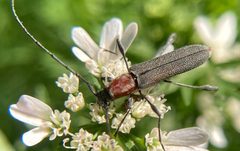
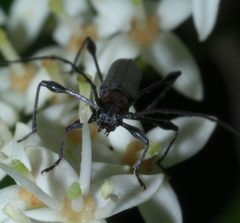
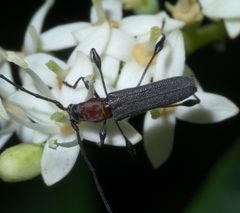
Rhopalophora longipes is a small, longhorned beetle and the only eastern North American representative of the tribe Rhopalophorini. The exhibits the characteristic black body with red and/or pronotum coloration typical of this tribe. are frequently observed on flowers during daylight hours. The species was first described by Thomas Say in 1824.
Pronunciation
How to pronounce Rhopalophora longipes: //ˌroʊpəˈlɒfərə ˈlɒŋɪˌpiːz//
These audio files are automatically generated. While they are not always 100% accurate, they are a good starting point.
Identification
Distinguished from other small cerambycids by its slender form, black , and red and pronotum. The tribe Rhopalophorini is characterized by distinctly (club-shaped) legs, a feature visible in this . Separated from the similar-appearing Cosmisoma species (which occur only in the Neotropics) by the absence of prominent antennal tufts. Distinguished from other eastern U.S. longhorned beetles by the combination of small size, flower-visiting , and the black-and-red color pattern.
Images
Distribution
Eastern United States. Extends northward from the largely Neotropical range of the tribe Rhopalophorini.
Behavior
and frequently found on flowers. Exhibits the characteristic slow, deliberate movement pattern of the Rhopalophorini rather than the rapid, frenetic movement typical of many other cerambycids.
Similar Taxa
- Cosmisoma brulleiSimilar black-and-red coloration and slender form, but Cosmisoma possess distinctive tufts of hair on the and are restricted to the Neotropics (South America).
- Other Rhopalophora speciesNumerous South American share the general facies of slender black body with red /pronotum, but these occur only in the Neotropics; R. longipes is the sole eastern U.S. representative of the .
- Zelus longipesUnrelated assassin bug that shares the specific epithet 'longipes' and similar coloration (red and black), but belongs to a different order (Hemiptera) and has very different and .
Sources and further reading
- BugGuide
- Wikipedia
- GBIF taxonomy match
- iNaturalist taxon
- Catalogue of Life
- Cerambycidae | Beetles In The Bush | Page 10
- Bugs in orange and black: Three assassins - milkweed assassin bug, Zelus longipes; orange assassin bug, Pselliopus barberi; and wheel bug, Arilus cristatus — Bug of the Week
- Bugs in orange and black – Three spooky assassins: milkweed assassin bug, Zelus longipes; orange assassin bug, Pselliopus barberi; and wheel bug, Arilus cristatus — Bug of the Week
- Friday Flower – Dwarf Spiderwort | Beetles In The Bush
- Bug Eric: Sundew Assassin Bugs: Zelus