
Rhopalophora
Species Guides
7- Rhopalophora angustata(Narrow-necked Rhopalophora)
- Rhopalophora bicolorella
- Rhopalophora cupricollis
- Rhopalophora longipes(Eastern Rhopalophora)
- Rhopalophora meeskei
- Rhopalophora prorubra
- Rhopalophora rugicollis
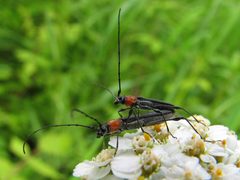
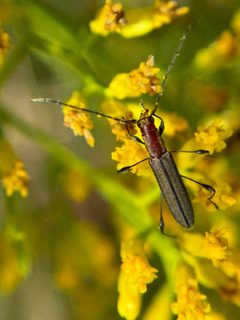
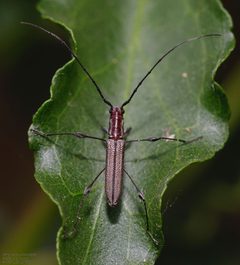
Rhopalophora is a of longhorn beetles ( Cerambycidae) in the tribe Rhopalophorini. Members are slender, beetles frequently found on flowers. The genus extends from the eastern United States southward through South America, with the nominate R. longipes occurring in eastern North America. The name derives from Greek rhopalon (club) and phero (to bear), referring to the distinctly club-shaped legs characteristic of the tribe.
Pronunciation
How to pronounce Rhopalophora: /ˌroʊ.pə.ləˈfɔː.rə/
These audio files are automatically generated. While they are not always 100% accurate, they are a good starting point.
Identification
Rhopalophora can be distinguished from similar cerambycids by their slender body form, black coloration with red and/or pronotum, and distinctly (club-shaped) legs. In R. collaris, the relative lengths of antennal segments and uniquely shaped pronotum serve as diagnostic features. Species in this lack the antennal tufts present in the related genus Cosmisoma, which can otherwise appear remarkably similar in general facies.
Images
Habitat
Found in association with flowering vegetation, particularly in open areas and along fence rows. In North America, occurs in association with milkweed (Asclepias spp.) and raspberry (Rubus neomexicanus). In South America, collected on Chilean goldenrod (Solidago chilensis) in Chaco Forest remnants.
Distribution
Eastern United States (at least R. longipes) southward through South America, including Argentina (Chaco Province). Specific distribution varies by .
Seasonality
active during daylight hours in autumn (March–April in Argentina; July–August in Arizona).
Host Associations
- Asclepias sp. - visitedcollected on stems and flowers
- Rubus neomexicanus - visitedcollected on flowers
- Solidago chilensis - visitedcollected on flowers in Argentina
- Ceanothus sp. - visitedcollected on flowers
Behavior
and frequently observed on flowers. Members of the tribe Rhopalophorini exhibit group mimicry, with their black-and-red coloration and slender form resembling small, flower-visiting —a form of .
Similar Taxa
- CosmisomaSimilar slender black-and-red appearance and flower-visiting , but distinguished by distinct tufts of hair on the (absent in Rhopalophora)
More Details
Group mimicry
Rhopalophora participate in group mimicry within the tribe Rhopalophorini, where multiple related species share a general resemblance to without mimicking any single protected species specifically.
Etymology
The name and tribe name derive from Greek rhopalon (club) and phero (to bear), referring to the club-shaped legs characteristic of members of this tribe.