
Phoracantha semipunctata
(Fabricius, 1775)
Australian Eucalyptus longhorn, Common Eucalyptus Longhorn, eucalyptus longhorned borer, firewood beetle
Phoracantha semipunctata is a wood-boring in the Cerambycidae, native to Australia and in many regions where Eucalyptus has been introduced. are , active during warmer evening hours when temperatures exceed 15°C. Females lay under loose bark or in bark crevices of stressed or freshly cut Eucalyptus trees; larvae bore into phloem and sapwood, potentially girdling and killing trees. The is a significant pest in plantations outside Australia, though in its native range are associated with drought-stressed trees.

Pronunciation
How to pronounce Phoracantha semipunctata: //ˌfɒrəˈkænθə ˌsɛmɪˌpʌŋkˈteɪtə//
These audio files are automatically generated. While they are not always 100% accurate, they are a good starting point.
Identification
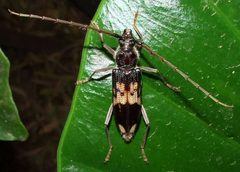
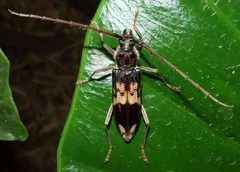
Distinguished from the congeneric P. recurva by larger size (15–23 mm vs. smaller in P. recurva) and more extensive dark markings on . The zigzag cream pattern on dark brown elytra is characteristic. Antennal length dimorphism (males longer) and presence of terminal abdominal spine aid identification. Larval galleries in inner bark and sapwood are diagnostic for .
Images
Habitat
Eucalyptus forests and plantations; in native Australia primarily attacks trees stressed by drought, fire, or other damage. In invaded ranges, attacks stressed or freshly cut Eucalyptus logs and living trees with compromised defenses. Found across humid, sub-humid, semi-arid and arid bioclimatic zones. Within trees, concentrated in lower, thicker stem sections with thicker bark.
Distribution
Native to Australia (widespread across mainland states). Introduced and established in: Europe (France, Italy, Portugal, Spain, Cyprus, Malta, Netherlands, Sweden, Switzerland); Africa (Algeria, Egypt, Ethiopia, Lesotho, Libya, Malawi, Mauritius, Morocco, Mozambique, Reunion, Rodrigues, South Africa, Swaziland, Tunisia, Zambia, Zimbabwe); Asia (Israel, Lebanon, Turkey); North America (California, USA); South America (Argentina, Bolivia, Brazil, Chile, Peru, Uruguay); Oceania (New Zealand, Papua New Guinea).
Seasonality
occurs primarily spring through autumn; in Southern California, adults present from late spring through late autumn. In Tunisia, emergence from April to September. activity and , beginning in evening and continuing at temperatures above 15–16°C. Complete spans 2–9 months depending on season: 3–4 months in spring/summer, up to 9 months in autumn/winter.
Diet
; larvae feed on inner bark, cambium, phloem, and outer sapwood of Eucalyptus . feed on pollen and nectar.
Host Associations
- Eucalyptus globulus - primary Highly susceptible
- Eucalyptus gomphocephala - primary Highly susceptible
- Eucalyptus camaldulensis - Some resistance
- Eucalyptus cladocalyx - Lower larval mortality at normal ; less attractive to
- Eucalyptus marginata - Jarrah; attacked in native range during drought
- Eucalyptus cinerea -
- Eucalyptus saligna -
- Eucalyptus leucoxylon -
- Eucalyptus occidentalis -
- Eucalyptus microtheca -
- Eucalyptus propinqua -
- Eucalyptus maculata - Larger larval galleries produced, indicating superior suitability
- Angophora costata - Myrtaceae; acceptable
- Corymbia calophylla - Marri; attacked in native range
Life Cycle
(2.5–3 mm, yellow, elongated oval) laid in batches of ~40 under loose bark or in bark crevices; hatch in 1–2 weeks. larvae bore through bark into cambium and phloem, feeding in galleries between phloem and sapwood for up to 2.5 months (70–180 days depending on moisture). Mature larvae (30–40 mm, cream, legless) burrow into sapwood or heartwood to form pupal chambers; lasts ~10 days. emerge through 8–10 mm exit holes in outer bark. Development time highly variable: 2 months under optimal warm, competitive conditions; >1 year in cold or dry conditions with larval .
Behavior
and activity pattern; initiated in evening when temperatures exceed 15°C. exhibit strong olfactory orientation to tree volatiles, flying upwind in narrow zigzags while in odor plume, executing counterturns and crosswind excursions when plume contact is lost. Males travel ~21% faster than females on host trees and actively seek mates via antennal contact; males guard females post-mating until oviposition, engaging in antennal taunting and biting of rival males. Females select oviposition sites based on larval development suitability, not visual cues alone.
Ecological Role
Native decomposer of stressed and dying Eucalyptus in Australia; contributes to nutrient cycling and stand renewal. In introduced ranges, acts as primary pest causing tree mortality in plantations and urban plantings. Can to densities 80× normal levels following severe drought. Resource partitioning observed among native (Braconidae) in Australia. Serves as prey/ for parasitoid Avetianella longoi and larval parasitoids Syngaster lepidus and Jarra phoracantha.
Human Relevance
Major economic pest of Eucalyptus plantations, windbreaks, and ornamental plantings worldwide outside Australia. Causes tree mortality through larval girdling of cambium. Management relies on silvicultural practices (irrigation, avoiding stress), ( releases), and resistance. In some invaded regions where Eucalyptus is itself considered , damage is viewed positively. Firewood transport has facilitated long-distance spread.
Similar Taxa
- Phoracantha recurvaCongeneric eucalyptus borer; smaller size, less extensive dark elytral markings, earlier seasonal , faster development, and differential susceptibility to Avetianella longoi (egg occurs in P. recurva but not P. semipunctata). P. recurva has displaced P. semipunctata in many regions including Tunisia and California.
More Details
Antennal Sensilla
bear basiconica I (20–26 μm, dull pointed, bent toward base) and II (10–20 μm, linear, dull pointed) distributed across flagellomeres, serving olfactory, , mechanoreceptive, thermoreceptive, and hygroreceptive functions essential for location.
Competitive Displacement
In Tunisia and California, P. semipunctata has been competitively displaced by P. recurva due to latter's earlier , faster development, and reduced vulnerability. Co-occurrence persists only in limited localities.
Drought-Outbreak Association
Severe drought in Southwestern Australia's Northern Jarrah Forest (2010–2011) triggered unprecedented with densities 80× higher than surrounding healthy forest, confirming drought as key outbreak driver in native range.
Sources and further reading
- BugGuide
- Wikipedia
- GBIF taxonomy match
- iNaturalist taxon
- NCBI Taxonomy
- Catalogue of Life
- Publications | Entomology Research Museum
- Phoracantha semipunctata . [Distribution map].
- Phoracantha semipunctata . [Distribution map].
- DISTRIBUTION, PREFERENCE AND PERFORMANCE OF PHORACANTHA RECURVA AND PHORACANTHA SEMIPUNCTATA (COLEOPTERA CERAMBYCIDAE) ON VARIOUS EUCALYPTUS SPECIES IN TUNISIA
- Host-finding by Phoracantha semipunctata: host volatiles, electroantennogram recordings and baited field traps
- Resource Partitioning among Parasitoids (Hymenoptera: Braconidae) of Phoracantha semipunctata in Their Native Range
- Outbreak of Phoracantha semipunctata in Response to Severe Drought in a Mediterranean Eucalyptus Forest
- Methods for rearing Syngaster lepidus and Jarra phoracantha (Hymenoptera: Braconidae), larval parasitoids of the phloem-colonizing longhorned beetles Phoracantha semipunctata and P. recurva (Coleoptera: Cerambycidae)
- Olfactory orientation responses of the eucalyptus woodborer, Phoracantha semipunctata, to host plant in a wind tunnel
- ATTRACTIVENESS AND SUITABILITY OF HOST TREE SPECIES FOR COLONIZATION AND SURVIVAL OF PHORACANTHA SEMIPUNCTATA (COLEOPTERA: CERAMBYCIDAE)
- Biological Constraints on Host-Range Expansion by the Wood-Boring Beetle Phoracantha semipunctata (Coleoptera: Cerambycidae)
- Olfactory orientation responses of the eucalyptus woodborer, Phoracantha semipunctata , to host plant in a wind tunnel
- Within-Tree Distribution and Survival of the Eucalyptus Longhorned Borer Phoracantha semipunctata (Coleoptera: Cerambycidae) in a Mediterranean-Type Ecosystem
- Phoracantha semipunctata (Coleoptera: Cerambycidae), a Serious Pest of Eucalyptus in California: Biology and Laboratory-Rearing Procedures
- Water relations of host trees and resistance to the phloem-boring beetle Phoracantha semipunctata F. (Coleoptera: Cerambycidae)
- Influence of the larval environment on performance and adult body size of the wood‐boring beetle Phoracantha semipunctata
- Projection of the Climate-Suitable Area of the Invasive Pest Phoracantha semipunctata (Coleoptera: Cerambycidae: Phoracantha) and Its Ability to Continue to Expand in China.