
Phoracantha recurva
Newman, 1840
lesser Eucalyptus longhorn, lesser Eucalyptus longhorn beetle
Phoracantha recurva is a medium-sized cerambycid beetle native to Australia that has been accidentally introduced to numerous countries worldwide. It is a phloem-colonizing wood-borer that causes extensive mortality in Eucalyptus plantations and landscape plantings. The has become over its P. semipunctata in many introduced regions, including Tunisia, due to competitive advantages such as earlier , faster development, and egg of . It is a significant pest of economic importance in the forestry industry.
Pronunciation
How to pronounce Phoracantha recurva: //ˌfɔrəˈkænθə rɪˈkɜrvə//
These audio files are automatically generated. While they are not always 100% accurate, they are a good starting point.
Identification
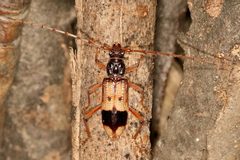
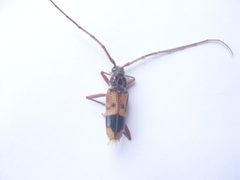
Medium-sized with complex pattern of cream and brown markings. Distinguished from the related P. semipunctata by smaller size and more limited dark markings. Basal portion of appears dominantly pale with only a few separated dark spots, rather than a series of closer markings as in P. semipunctata.
Images
Habitat
Eucalyptus plantations and landscape plantings; specifically attracted to stressed Eucalyptus trees or freshly cut logs where mate. Found across humid, sub-humid, semi-arid and arid bioclimatic areas in introduced range.
Distribution
Native to Australia (New South Wales, Northern Territory, Queensland, South Australia, Tasmania, Victoria, Western Australia). Introduced to: Europe (Greece, Italy, Portugal, Spain), Asia (Turkey), Africa (Libya, Malawi, Morocco, South Africa, Tunisia, Zambia), North America (California, USA), South America (Argentina, Brazil, Chile, Uruguay), Oceania (New Zealand, Papua New Guinea).
Diet
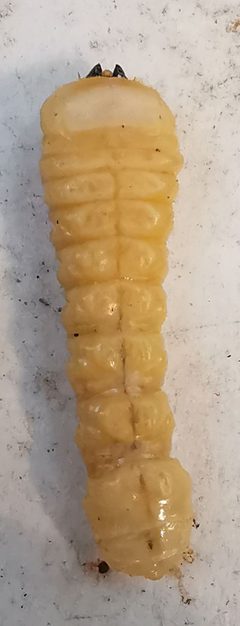
; larvae bore galleries between phloem and sapwood of Eucalyptus trees. do not feed on wood.
Host Associations
- Eucalyptus gomphocephala - plantpreferred
- Eucalyptus camaldulensis - plantpreferred
- Eucalyptus cinerea - plant
- Eucalyptus saligna - plant
- Eucalyptus astrengins - plant
- Eucalyptus leucoxylon - plant
- Eucalyptus occidentalis - plant
- Eucalyptus microtheca - plant
- Cupressus lusitanica - plantMexican cypress
- Angophora spp. - plantgum myrtle
- Syncarpia spp. - plantturpentine tree
Life Cycle
Females lay batches under loose bark (smooth bark) or in bark crevices (fissured bark). larvae bore into inner bark, pass through bark and phloem, and feed in galleries between phloem and sapwood until maturity. Mature larvae burrow into sapwood to pupate. emerge from pupal chambers.
Behavior
attracted to stressed Eucalyptus trees or freshly cut logs where they mate. Adult begins in evening and continues through night at temperatures above 16°C. Attack densities higher on lowest parts of tree stems than upper parts. encapsulate and kill eggs of Avetianella longoi, providing competitive advantage over P. semipunctata.
Ecological Role
Pest of Eucalyptus plantations; causes damage to trees through larval boring. In native Australian range, does not cause economic damage; in introduced range, causes heavy damage to trees. Interacts with Avetianella longoi through egg . Subject of programs using larval parasitoids Syngaster lepidus and Jarra phoracantha.
Human Relevance
Significant forestry pest causing extensive mortality in Eucalyptus plantations and landscape plantings worldwide. Target of integrated management programs combining silvicultural practices, , and . Mass rearing protocols developed for its to support biological control efforts.
Similar Taxa
- Phoracantha semipunctataSimilar size and habit; distinguished by larger size, more extensive dark markings, and series of closer markings on basal rather than separated dark spots. P. recurva has become over P. semipunctata in many introduced regions due to competitive advantages.
Sources and further reading
- BugGuide
- Wikipedia
- GBIF taxonomy match
- iNaturalist taxon
- NCBI Taxonomy
- Catalogue of Life
- Publications | Entomology Research Museum
- Bug Eric: Kissing Bugs
- Pensoft Editorial Team | Blog - Part 145
- Pensoft blog - Part 147
- Phoracantha recurva . [Distribution Map].
- DISTRIBUTION, PREFERENCE AND PERFORMANCE OF PHORACANTHA RECURVA AND PHORACANTHA SEMIPUNCTATA (COLEOPTERA CERAMBYCIDAE) ON VARIOUS EUCALYPTUS SPECIES IN TUNISIA
- Methods for rearing Syngaster lepidus and Jarra phoracantha (Hymenoptera: Braconidae), larval parasitoids of the phloem-colonizing longhorned beetles Phoracantha semipunctata and P. recurva (Coleoptera: Cerambycidae)
- Suitability of the Eggs of Two Species of Eucalyptus Longhorned Borers (Phoracantha recurva and P. semipunctata) as Hosts for the Encyrtid Parasitoid Avetianella longoi