
Phoracanthini
Genus Guides
1- Phoracantha(Eucalyptus Longhorn Beetles)
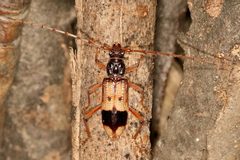
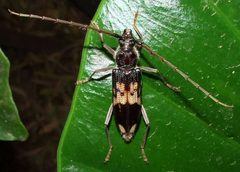
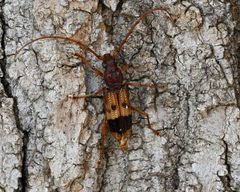
Phoracanthini is a tribe of longhorn beetles in the Cerambycinae, containing twelve recognized distributed primarily across the Australasian, Oriental, and Indo-Pacific regions. The tribe includes economically significant genera such as Phoracantha, known for their association with Eucalyptus trees. Member genera exhibit substantial diversity in body form and elytral patterning, with many displaying distinctive spotted or banded coloration.
Pronunciation
How to pronounce Phoracanthini: /foʊrəˈkænθɪnaɪ/
These audio files are automatically generated. While they are not always 100% accurate, they are a good starting point.
Identification
Tribe-level identification requires examination of genitalic and antennal characters; members generally possess or slightly serrate and lack the extreme elongation seen in some other cerambycine tribes. The Phoracantha is distinguished by its flattened body form and bold elytral patterns of yellow or orange on black, while Coptocercus typically show more elongate bodies with variable maculation. Thoris species are characterized by their distinctive spotted and specific genitalic structures used to define species groups.
Images
Distribution
Australia, New Guinea, New Zealand, Oriental region including Malaysia, Thailand, Indochina, Borneo, Indonesia (Sumatra, Java), and Pacific islands. The tribe shows strong biogeographic affinities with the Australian-New Guinean region, with subsequent into Southeast Asia.
Human Relevance
Members of the Phoracantha, particularly P. semipunctata and P. recurva, are significant forestry pests of Eucalyptus plantations worldwide, having been introduced to multiple continents outside their native Australian range. Their establishment in novel environments has necessitated programs and measures.
Similar Taxa
- TmesisterniniOverlaps in Australasian distribution and general body form; distinguished by different antennal structure and male genitalia .
- AcanthocininiShares elongate body form in some ; separated by tribal-level characters of the prothorax and insertions.
More Details
Taxonomic composition
The tribe comprises twelve : Atesta, Allotisis, Coleocoptus, Coptocercus, Epithora, Paratesta, Phytrocaria, Phoracantha, Semiphoracantha, Skeletodes, Steata, and Thoris. Phylogenetic studies within constituent genera suggest complex biogeographic histories linked to the geological evolution of New Guinea and Australia.
Research focus
Recent systematic revisions have focused on Coptocercus (36 , 21 described as new in 1995), Thoris (eight species with three species-groups recognized), and Allotisis. These studies emphasize that much of the tribe's diversity remains taxonomically underexplored, particularly in New Guinea and the Oriental region.
Sources and further reading
- BugGuide
- Wikipedia
- iNaturalist taxon
- NCBI Taxonomy
- Catalogue of Life
- Taxonomy, phylogeny and distribution of the longicorn beetle genus Allotisis Pascoe (Coleoptera: Cerambycidae: Phoracanthini)
- Systematics and biogeography of the Australian – New Guinean genus Thoris Pascoe (Coleoptera : Cerambycidae : Phoracanthini)
- New data on the taxonomy and geographic distribution of Oriental species of the genus Coptocercus Hope, 1841 (Coleoptera: Cerambycidae: Phoracanthini)
- A revision of the Australasian genus Coptocercus Hope (Coleoptera : Cerambycidae : Phoracanthini), with descriptions of twenty-one new species