
Tylonotus bimaculatus
Haldeman, 1847
Ash and Privet Borer
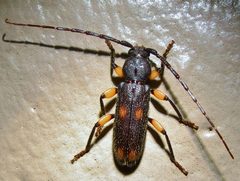
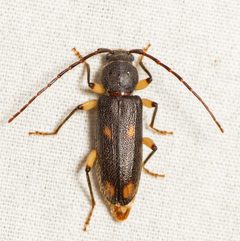
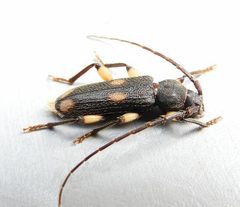
Tylonotus bimaculatus is a longhorn beetle (Cerambycidae) described by Haldeman in 1847. Commonly known as the Ash and Privet Borer, this is documented across North America with over 1,000 iNaturalist observations. As a member of the Cerambycinae and tribe Hesperophanini, it belongs to a group of wood-boring beetles whose larvae typically develop in hardwood trees.
Pronunciation
How to pronounce Tylonotus bimaculatus: //taɪloʊˈnoʊtəs ˌbaɪmæˈkjuleɪtəs//
These audio files are automatically generated. While they are not always 100% accurate, they are a good starting point.
Images
Distribution
North America, with confirmed records from Manitoba, Ontario, and Québec in Canada. GBIF distribution records indicate presence across the continent.
Host Associations
- Fraxinus - larval ash trees, per
- Ligustrum - larval privet, per
Similar Taxa
- Other Tylonotus speciescongeneric share similar and wood-boring habits; precise identification requires examination of elytral markings and antennal proportions
- Other Hesperophaninitribe members share elongate cylindrical bodies and cryptic coloration; T. bimaculatus distinguished by characteristic two-spotted pattern implied by specific epithet
More Details
Taxonomic Note
The specific epithet 'bimaculatus' (two-spotted) suggests distinctive elytral markings, though detailed morphological descriptions are not available in the provided sources. The was among the early North American cerambycids described by Samuel Stehman Haldeman, a prominent 19th-century American naturalist.
Nomenclatural Stability
The has maintained stable since its original description in 1847, with no recorded synonymy or taxonomic revisions in major databases (Catalogue of Life, GBIF, NCBI all list as accepted).
Sources and further reading
- BugGuide
- Wikipedia
- GBIF taxonomy match
- iNaturalist taxon
- NCBI Taxonomy
- Catalogue of Life
- Please Pass the Chocolate Chirp Cookies | Bug Squad
- Home invaders III - Fall field cricket, Gryllus pennsylvanicus — Bug of the Week
- What’s all this chirping about? Ask the fall field cricket, Gryllus pennsylvanicus — Bug of the Week
- The troubadour downstairs – fall field cricket, Gryllus pennsylvanicus — Bug of the Week
- Field crickets invade a home with a wake-up call: Fall field cricket, Gryllus pennsylvanicus — Bug of the Week
- Cricket Virus Leads to Illegal Importation of Foreign Species for Pet Food