
Trichoferus campestris
(Faldermann, 1835)
velvet longhorned beetle
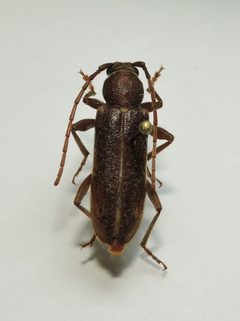
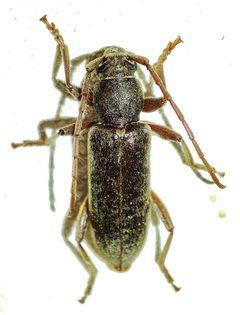
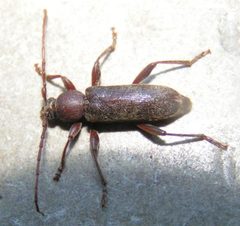
Trichoferus campestris is a wood-boring longhorn beetle native to eastern Asia that has become an in North America and Europe. are active from early summer, with peak abundance around 650 (base 10°C) in early July in Minnesota. The is , with documented on multiple hardwood species including Acer platanoides, Juglans nigra, and Malus domestica. Larvae develop in woody material and can complete development in cut branches.
Pronunciation
How to pronounce Trichoferus campestris: //ˌtrɪkoʊˈfɛrəs kæmˈpɛstrɪs//
These audio files are automatically generated. While they are not always 100% accurate, they are a good starting point.
Images
Habitat
Associated with woody vegetation in both native and introduced ranges. In North America, has been detected in suburban parks and urban environments, with traps in Tilia trees capturing significantly more than those in Quercus. Develops in living and cut wood of various hardwood .
Distribution
Native to eastern Asia including China, North Korea, South Korea, Japan, Mongolia, and eastern Russia. Introduced and established in North America (USA and Canada, first detected 1997 in New Jersey), and multiple European countries including Germany, Austria, Belgium, France, Italy, Poland, Romania, UK, and others. Range expanding westward in Europe and within North America.
Seasonality
activity is unimodal with peak abundance in early July in Minnesota (around 650 , base 10°C). Active during summer months in temperate regions.
Diet
wood-feeder. In native Asia, feeds on multiple tree . In North America, documented include Acer platanoides (Norway maple), Juglans nigra (black walnut), Malus domestica (apple), and Acer saccharum (sugar maple). Oviposition and larval development occur more readily on Juglans nigra and Malus domestica than on Acer saccharum or Pinus strobus.
Host Associations
- Acer platanoides - larval First confirmed record in North America; declining tree in Mississauga, Ontario
- Juglans nigra - larval Preferred for oviposition and larval development in choice experiments
- Malus domestica - larval Preferred for oviposition and larval development; oviposition higher on cankered than uncankered wood
- Acer saccharum - larval Supports oviposition and development less readily than Juglans or Malus
- Pinus strobus - larval Supports oviposition and development less readily than preferred hardwood
Life Cycle
laid on cut branches or woody material. Larvae develop within wood, with development benefiting from cold exposure during . emerge from infested wood. Can complete development in dry wood, facilitating establishment in transported wood products.
Behavior
are attracted to -baited traps. Females show oviposition preference for certain and for cankered over uncankered apple wood. Has been observed taking over active nests of other in related cerambycid species.
Ecological Role
Wood-boring that develops in hardwood trees and cut wood. Not considered a primary pest of living trees in Ontario based on feeding damage examination. Serves as for Solenura ania (Pteromalidae).
Human Relevance
of phytosanitary concern. Subject to detection efforts by Canadian Food Inspection Agency through incubation of logs from declining trees at high-risk introduction sites. Intercepted in wood packaging material. Potential pest of live trees, wood furniture, and orchard trees.
Similar Taxa
- Other Trichoferus species-level characters require examination of antennal structure and body proportions; T. campestris distinguished by specific antennal segment ratios and elytral pattern
- Other Hesperophanini cerambycidsTribe members share elongate body form and antennal characteristics; identification requires detailed examination of genitalia and punctation patterns
More Details
Parasitoid relationships
The giant pteromalid Solenura ania is an ectoparasitoid of T. campestris. The female wasp is approximately 28 mm long and metallic blue, while the male is only about 6 mm and metallic green, showing extreme .
Detection methods
-baited traps deployed in suburban parks have proven effective for monitoring abundance, with significantly higher capture rates in Tilia compared to Quercus trees.
Sources and further reading
- BugGuide
- Wikipedia
- GBIF taxonomy match
- iNaturalist taxon
- NCBI Taxonomy
- Catalogue of Life
- Bug Eric: How to (Almost) Catch a Leaf-tier Caterpillar (Video)
- Friday flower – Sabatia angularis | Beetles In The Bush
- ID Challenge #1 | Beetles In The Bush
- Seasonal Phenology of Velvet Longhorned Beetle, Trichoferus campestris (Coleoptera: Cerambycidae) in Minnesota
- Worldwide distribution and theoretical spreading of Trichoferus campestris (Coleoptera: Cerambycidae) depending on the main climatic elements
- Discovery ofTrichoferus campestris(Coleoptera: Cerambycidae) in Ontario, Canada and first host record in North America
- Range expansion of <i>Trichoferus campestris</i> (Faldermann) (Coleoptera: Cerambycidae) in Europe with the confirmation of its presence in Romania
- First description of the male of Solenura ania (Walker) (Hymenoptera: Pteromalidae), a giant pteromalid parasitoid of Trichoferus campestris (Faldermann), with special reference to its sexual dimorphism
- Ovipositional behaviour and larval performance of Trichoferus campestris (Faldermann) (Coleoptera: Cerambycidae) on cut branches of four North American tree species
- Figure 4 from: Cao L, Cui J, Wang X, Wang G, Yang Z (2020) First description of the male of Solenura ania (Walker) (Hymenoptera: Pteromalidae), a giant pteromalid parasitoid of Trichoferus campestris (Faldermann), with special reference to its sexual dimorphism. Biodiversity Data Journal 8: e54961. https://doi.org/10.3897/BDJ.8.e54961