
Stenosphenus notatus
(Olivier, 1795)
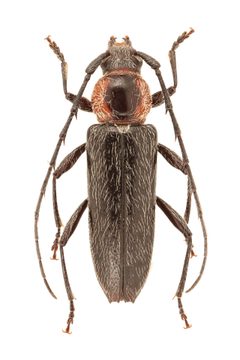
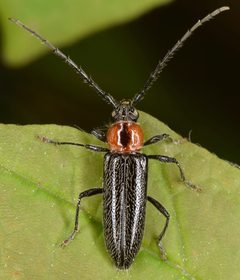
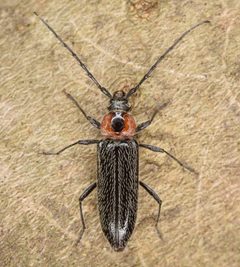
Stenosphenus notatus is a longhorned beetle (Cerambycidae) native to eastern North America. It is notable for its exceptionally early spring , appearing during the first warm days of late March and disappearing before most other longhorned beetles become active. The is closely associated with hickory trees (Carya), where larvae develop beneath the bark of dead limbs. overwinter, an unusual strategy among eastern U.S. cerambycids.
Pronunciation
How to pronounce Stenosphenus notatus: //ˌstɛn.əˈsfiː.nəs noʊˈteɪ.təs//
These audio files are automatically generated. While they are not always 100% accurate, they are a good starting point.
Identification
Easily overlooked due to early seasonality rather than cryptic appearance. Distinguished from later-emerging longhorned beetles by its presence in late March to early April. Association with freshly dead Carya wood provides a clue. Specific morphological diagnostic features are not documented in available sources.
Images
Habitat
Dead and dying wood of hickory trees (Carya), particularly recently fallen or dead limbs and trunk sections. found on material during early spring.
Distribution
Eastern North America, including Missouri and surrounding states; recorded from Ontario and Québec, Canada. Described as one of the more common cerambycid in Missouri and throughout the eastern U.S.
Seasonality
active from late March through early April in Missouri; among the earliest-emerging longhorned beetles in the region. Disappears before the main activity period of most cerambycid in late spring and early summer.
Diet
Larvae feed beneath bark of dead Carya limbs; development requires two seasons. do not feed on material.
Host Associations
- Carya alba - larval mockernut hickory; reared from dead branches and trunk sections
- Carya aquatica - larval water hickory; confirmed larval
- Carya laciniosa - larval shellbark hickory; confirmed larval
- Carya ovata - larval shagbark hickory; confirmed larval
- Carya - larval -level association; primary larval are hickories and pecan
- Celtis - possible incidental associationhackberry; recorded in literature but not confirmed as true larval ; suspected to represent incidental occurrence rather than breeding substrate
Life Cycle
Requires two years to complete development. Larvae feed in dead Carya wood for two seasons. occurs in latter part of second season, with to before winter onset. Adults overwinter in pupal chambers, emerging when warm temperatures return in spring to seek freshly dead material for oviposition.
Behavior
seek out dead hickory wood that has died within the past few months for -laying. Has been observed with pseudoscorpions attached to legs, representing apparent —pseudoscorpions use the for to new dead wood .
Ecological Role
Wood-boring contributing to decomposition of dead hickory wood. Serves as for pseudoscorpions and possibly other organisms inhabiting dead tree microhabitats.
Similar Taxa
- Other Cerambycidae speciesMost eastern U.S. longhorned beetles emerge later in spring and summer; S. notatus distinguished by March-April activity period and strong Carya association.
- Dicerca luridaShares hickory association and early spring occurrence, but belongs to different (Buprestidae) with distinct ; often found together on same fallen hickory trunks.
More Details
Overwintering strategy
is rare among eastern U.S. longhorned beetles. Most overwinter as larvae in wood, resuming development in spring. S. notatus pupates and transforms to adult before winter, enabling immediate spring without the developmental delay experienced by most .
Phoretic associations
Pseudoscorpions have been documented attached to S. notatus legs, likely representing for to new dead wood . This association has been proposed as a mechanism for pseudoscorpion of ephemeral dead tree substrates, though alternative hypotheses (accidental attachment, attempt) have not been excluded.
Host specificity
Near-monophagous on Carya; one of the more -specific eastern cerambycids. Literature records of Celtis association are considered dubious and possibly represent incidental presence rather than true larval development.