
Clytus planifrons
(LeConte, 1874)
Clytus planifrons is a long-horned beetle in the Cerambycidae, described by John Lawrence LeConte in 1874. The occurs along the Pacific coast of North America, with records from California, Oregon, Washington, and British Columbia. As a member of the Clytini tribe, it belongs to a group of beetles often characterized by -mimicking coloration and patterns.
Pronunciation
How to pronounce Clytus planifrons: //ˈklaɪtəs ˈplænɪfrɒnz//
These audio files are automatically generated. While they are not always 100% accurate, they are a good starting point.
Identification
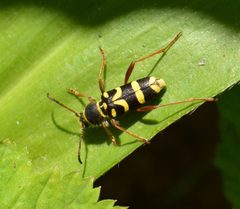
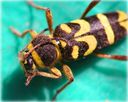
Clytus planifrons can be distinguished from related Clytus by its flattened (forehead), which is the source of its specific epithet "planifrons" (flat-fronted). The species exhibits the typical Clytus pattern of yellow and black banding on the . It can be separated from the similar Clytus ruricola by differences in antennal length and the precise configuration of elytral markings. The pronotum lacks the strong spines or projections found in some other cerambycid .
Images
Habitat
Found in forested and woodland along the Pacific coast, where it develops in dead and decaying hardwood. The is associated with oak (Quercus) and other hardwood .
Distribution
Pacific coast of North America: California, Oregon, Washington (United States); British Columbia (Canada). Records also include Alberta, Canada, suggesting some interior distribution or vagrant occurrences.
Seasonality
are active from late spring through summer, with peak activity typically occurring during the warmer months when flowers are available for feeding.
Diet
Larvae feed on dead and decaying hardwood, particularly oak (Quercus spp.). have been observed feeding on flower nectar and pollen.
Host Associations
- Quercus - larval primary
Life Cycle
Complete with , larva, pupa, and stages. Larvae are wood-borers that develop in dead hardwood branches and trunks, taking one to two years to mature. occurs in the wood, and adults emerge through exit holes.
Behavior
are and active fliers, often visiting flowers for nectar. The exhibits -mimicking , including rapid, erratic patterns that resemble hymenopteran movement.
Ecological Role
As a saproxylic , larvae contribute to wood decomposition and nutrient cycling in forest . may serve as when visiting flowers.
Human Relevance
Occasionally encountered by entomologists and naturalists. The has no significant economic impact; it is not considered a pest of living trees or structural timber.
Similar Taxa
- Clytus ruricolaOverlapping distribution and similar elytral pattern; distinguished by antennal length and structure
- Clytus marginicollisSimilar -mimicking appearance; C. planifrons has more extensive yellow markings and flattened
- Neoclytus spp.Similar size and coloration; Neoclytus typically have more pronounced pronotal spines and different antennal proportions
More Details
Taxonomic history
Described by John Lawrence LeConte in 1874 based on specimens from the Pacific coast. The has remained relatively stable in its taxonomic placement within the Clytus.
Etymology
The specific epithet "planifrons" refers to the flattened or plane (forehead) of this , a diagnostic character separating it from .