
Clytus marginicollis
Castelnau & Gory, 1841
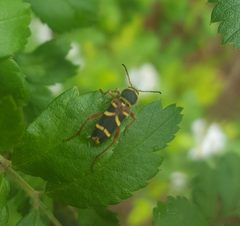
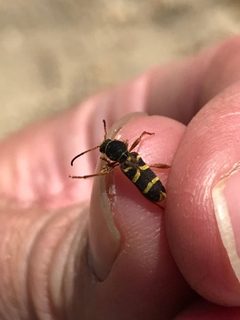
Clytus marginicollis is a small longhorn beetle in the Cerambycidae, described by Castelnau and Gory in 1841. are mimics with distinctive black and yellow coloration. The occurs in eastern North America, where larvae develop in dead pine branches and adults are often found under pine bark.

Pronunciation
How to pronounce Clytus marginicollis: //ˈklaɪtəs mɑːrˌdʒɪnɪˈkɒlɪs//
These audio files are automatically generated. While they are not always 100% accurate, they are a good starting point.
Images
Habitat
Associated with pine forests; larvae develop in dead pine branches, found under bark of pines.
Distribution
Eastern North America; recorded from Canada (New Brunswick, Nova Scotia, Ontario, Québec) and presumably adjacent United States.
Diet
Larvae feed on dead pine branches. diet not documented.
Host Associations
- Pinus - larval development in dead branches; microhabitat under barkpine
Similar Taxa
- Clytus ruricolaSimilar -mimic appearance with yellow-banded ; distinguished by length and pattern details
- Other Clytus species members share -mimicry and banded coloration; require careful examination of elytral pattern and antennal proportions for separation
More Details
Taxonomic Note
Authorship sometimes cited as Laporte and Gory 1835 in older sources, but accepted authority is Castelnau & Gory, 1841.
Mimicry
are mimics (), with black and yellow banding and wasp-like body form that likely reduces .