
Calloides nobilis mormonus
Schaeffer, 1911
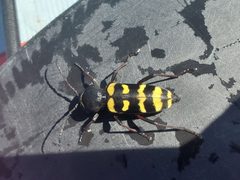
Calloides nobilis mormonus is a western North American of longhorn beetle ( Cerambycidae) in the tribe Clytini. The nominate subspecies C. n. nobilis occurs in eastern North America, while C. n. mormonus is restricted to western regions. This subspecies has been documented from burned coniferous forest in Arizona and attracted to sweet red wine-baited traps. The is associated with fire-damaged oak and conifer wood, suggesting a reliance on recently dead or stressed woody .
Pronunciation
How to pronounce Calloides nobilis mormonus: /kæˈloʊ.aɪdiːz ˈnoʊ.bɪ.lɪs mɔrˈmoʊ.nəs/
These audio files are automatically generated. While they are not always 100% accurate, they are a good starting point.
Identification
Distinguished from the nominate C. n. nobilis by geographic separation: C. n. mormonus occurs in western North America while C. n. nobilis is eastern. Separation from other Clytini members likely involves antennal and elytral pattern characteristics, though specific diagnostic features for this subspecies are not documented in available sources. The subspecies name suggests morphological differentiation established by Schaeffer in 1911, though the nature of these differences is not specified in accessible literature.
Images
Habitat
Documented from burned coniferous forest on the Kaibab Plateau in northern Arizona, specifically in areas recovering from wildfire. Associated with fire-damaged pinyon-juniper woodland and ponderosa pine forest at elevations around 6600 feet. The context suggests preference for recently disturbed or fire-affected woody environments.
Distribution
Western North America: documented from Arizona (Kaibab Plateau, Coconino County), with GBIF records indicating presence in California and the United States broadly. The replaces the nominate C. n. nobilis in western regions.
Seasonality
activity recorded in early September in northern Arizona. This late-season activity pattern contrasts with earlier seasonal peaks observed in related cerambycid at the same latitude.
Diet
Larvae bore into wood of fire-damaged or recently dead trees; specific plant records include oak (Quercus) and conifers (Pinus, Juniperus). feeding habits unknown.
Host Associations
- Pinus ponderosa - larval fire-damaged or recently dead wood
- Juniperus osteosperma - larval fire-damaged or recently dead wood
- Quercus - larval fire-damaged oak; inferred from nominate rearing records
Life Cycle
Complete with wood-boring larval stage. Larvae develop in fire-damaged or recently dead woody . timing appears to coincide with late summer to early fall in at least part of the range. Specific duration of developmental stages unknown.
Behavior
attracted to sweet red wine-baited jug traps, suggesting response to fermentation cues. activity on tree trunks has not been documented for this specifically, though this is common in related cerambycids.
Ecological Role
Primary decomposer of fire-killed or recently dead woody in coniferous and mixed forest . Contributes to nutrient cycling in post-fire successional . May serve as prey for woodpeckers and other in burned forest environments.
Human Relevance
Of interest to coleopterists and forest entomologists studying post-fire insect . The ' attraction to wine-baited traps makes it amenable to survey and monitoring efforts in burned forest rehabilitation areas.
Similar Taxa
- Calloides nobilis nobilisThe nominate eastern ; distinguished by distribution (eastern vs. western North America) and subtle morphological differences established by original description.
- Other Clytini members (e.g., Placosternus, Megacyllene)Similar antennal structure and elytral patterning; precise separation requires examination of genitalic and antennomere characteristics not detailed in field accounts.
More Details
Fire association
The specimen documented in the source material was captured in a burn zone following the White Sage Fire on the Kaibab Plateau, representing the first documented western occurrence of this for the collector. This fire association parallels the nominate subspecies, which has been reared from fire-damaged oak in Missouri.
Taxonomic note
Originally described by Schaeffer in 1911 as a full or variety, now treated as a western of the polymorphic C. nobilis. The subspecific status reflects geographic replacement rather than sympatric occurrence with the nominate form.