
Semanotus japonicus
Lacordaire, 1869
sugi bark borer, Cryptomeria bark borer
Semanotus japonicus is a cerambycid beetle native to Japan that attacks living Japanese cedar (Cryptomeria japonica). Larvae feed primarily within the inner bark of trunks, where they are vulnerable to drowning by resin flow. The exhibits a transitional ecological state between primary and secondary bark borer, requiring adequate nutrition but lacking defenses against host resin defenses. are relatively sedentary, with limited between-tree movement and mating activity concentrated from sunset to sunrise.
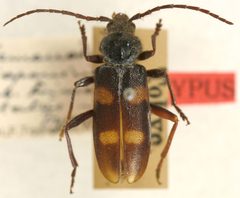
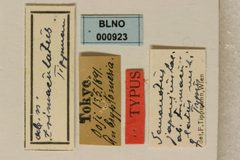
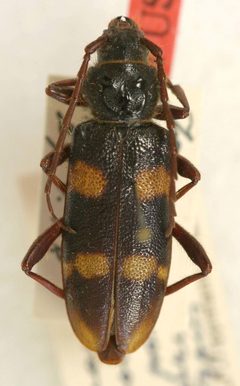
Pronunciation
How to pronounce Semanotus japonicus: //sɛˈmænətəs dʒəˈpɒnɪkəs//
These audio files are automatically generated. While they are not always 100% accurate, they are a good starting point.
Identification
can be distinguished from related Semanotus by association with Cryptomeria japonica trees and hole patterns on trunks. Larval galleries occur in the inner bark rather than deep wood. Exact morphological diagnostic features distinguishing S. japonicus from are not detailed in available sources.
Images
Habitat
Mature and young Japanese cedar (Cryptomeria japonica) stands and plantations. occur on living cedar trees in forest interiors. Larval development occurs within the inner bark of trunks.
Distribution
Native to Japan: Honshu, Shikoku, Sado Island, Oki Island, and Yaku Island. GBIF records also indicate presence in North America and Canada, though these likely represent introduced or misidentified requiring verification.
Seasonality
and activity begins in spring, with timing varying by year based on post-hibernation temperatures. Adults emerged earlier in warmer springs (e.g., 1981 vs. 1984 in Japanese studies).
Diet
Larvae feed on inner bark phloem tissues of living Cryptomeria japonica. do not feed on tissues; mouthparts are not adapted for feeding.
Host Associations
- Cryptomeria japonica - obligate Primary and obligate for larval development. Larvae feed in inner bark of living trees.
- Chamaecyparis obtusa - secondary Occasionally attacked according to some Japanese forest entomology literature, though less preferred than Cryptomeria japonica.
Life Cycle
are deposited on bark of trees. Newly hatched larvae tunnel into inner bark and feed within phloem tissue, creating galleries. Larvae are vulnerable to mortality from resin flow in healthy trees. Development completes within host, with emerging through exit holes in bark. Adult longevity averages 7–12 days in field conditions.
Behavior
are , with mating activity concentrated from sunset to sunrise. Males possess excellent female-searching ability and typically locate females within 24 hours even at low densities. Males use close-range olfactory cues and visual cues to locate females; female body surface contains a stable, non-volatile contact that elicits male copulatory . Both sexes engage in multiple mounts and copulations with multiple partners. Mounting and copulation are brief (majority under 10 and 5 minutes, respectively). Two types of male-male combat occur: between solitary males, and between solitary males and pair-forming males, with the latter being more frequent and intense. Adults exhibit limited : mean movement distances of 9–16 meters between trees, with maximum recorded dispersal of 80–150 meters. Movement consists of small- at cool temperatures and larger-scale at warm temperatures. Between-tree movement is infrequent, resulting in contagious spatial distribution.
Ecological Role
Functions as a bark borer in a transitional ecological state between primary and secondary insect. Attacks living trees but requires stress or reduced vigor to successfully establish, as larvae are defenseless against resin flow in vigorous hosts. Contributes to tree mortality in stressed cedar stands and may accelerate decline of suppressed or damaged trees. Serves as host for specialized including Doryctes yogoi (Braconidae).
Human Relevance
Significant forest pest of Japanese cedar, a major timber and plantation in Japan. occur in young cedar plantations, causing economic damage through reduced timber quality and tree mortality. Management interest includes research using . Not known to attack non-native cedar plantings outside Japan, though monitoring is warranted given global trade in Cryptomeria.
Similar Taxa
- Semanotus litigiosusCongeneric North American bark borer; distinguished by geographic range and association with different conifers (Thuja, Chamaecyparis in North America vs. Cryptomeria in Japan).
- Callidiellum rufipenneAnother cerambycid bark borer in Japanese cedar; distinguished by larval gallery depth and , though specific diagnostic characters require examination.
- Other Semanotus speciesMorphological separation requires examination of genitalia and subtle body proportions; ecological separation by association is more practical for field identification.
More Details
Chemical ecology
Mating is mediated by a contact on the female body surface consisting of n-, methyl-, dimethyl- and trimethylalkanes and methyl- and dimethylalkenes with 25–30 carbon atoms. Male extract contains masking hydrocarbons that prevent male-male mating attempts.
Population dynamics
sex ratios are male-biased, especially early in the period, due to protandry (earlier male ). estimates using mark-recapture indicate daily survival rates of 0.86–0.92.
Resin defense vulnerability
Experimental studies demonstrate that larval mortality from resin flow is near 100% in unstressed, vigorous trees. Heavy pruning or stem cutting reduces resin flow and improves larval survival, while girdling creates nutritional gradients that allow partial survival above the girdle.
Sources and further reading
- BugGuide
- Wikipedia
- GBIF taxonomy match
- iNaturalist taxon
- NCBI Taxonomy
- Catalogue of Life
- Researchers Find La Crosse Virus in Aedes japonicus Mosquitoes
- Why Taxonomic Preparedness is Critical for Invasive Species Response
- In Search for Better Stink Bug Management, Scientists Look Up
- Water Mites Discovered Parasitizing Two Mosquito Species in Pennsylvania
- Non-native pest-controlling wasp in Canada | Blog
- 12 new weevil species discovered using advanced imaging tools
- Mating Behavior of the Cryptomeria Bark Borer, Semanotus japonicus LACORDAIRE(Coleoptera:Cerambycidae)
- The Mating Behavior of Adults of the Sugi Bark Borer, Semanotus japonicus Lacordaire (Coleoptera: Cerambycidae).
- Function of Contact Pheromone in the Mating Behavior of the Cryptomeria Bark Borer, Semanotus japonicus LACORDAIRE(Coleoptera:Cerambycidae)
- Spatial Distribution Pattern of the Sugi Bark Borer, Semanotus japonicus LACORDAIRE (Coleoptera : Cerambycidae), on Japanese Cedar Trees
- Adult populations of the sugi bark borer, Semanotus japonicus Lacordaire (Coleoptera: Cerambycidae), in Japanese cedar stands: Population parameters, dispersal, and spatial distribution
- Differential Host Residence of Adult Cryptomeria Bark Borer,Semanotus japonicusLacordaire (Coleoptera: Cerambycidae), in Relation to Tree Size of Japanese Cedar,Cryptomeria japonicaD. Don
- Bark borer Semanotus japonicus (Col., Cerambycidae) utilization of Japanese cedar Cryptomeria japonica: a delicate balance between a primary and secondary insect
- An Outbreak of the Cryptomeria Bark Borer, Semanotus japonicus LACORDAIRE(Coleoptera:Cerambycidae), in a Young Japanese Cedar(Cryptomeria japonica D.DON)Plantation : II. Between-Tree Distribution of Adult Emergence Holes and Its Relation to Tree Size
- Experimental release of a parasitoid, Doryctes yogoi Watanabe (Hymenoptera: Braconidae), onto Semanotus japonicus Lacordaire (Coleoptera: Cerambycidae) inoculated into live Japanese cedar trees (Cryptomeria japonica D.DON)
- An Outbreak of the Cryptomeria Bark Borer, Semanotus japonicus LACORDAIRE(Coleoptera:Cerambycidae)in a Young Japanese Cedar(Cryptomeria japonica D.DON)Plantation. : I.Annual Fluctuations in Adult Population Size and Impact on Host Trees
- The Spatial Distribution Pattern of Adult Emergence Holes of the Sugi Bark Borer, Semanotus japonicus(Lacordaire)(Coleoptera;Cerambycidae) in a Japanese Cedar Stand.