
Semanotus
Mulsant, 1839
Species Guides
8- Semanotus amethystinus(Amethyst Cedar Borer)
- Semanotus amplus
- Semanotus conformis
- Semanotus japonicus(sugi bark borer)
- Semanotus juniperi
- Semanotus ligneus(Cedar Tree Borer)
- Semanotus litigiosus(Firtree Borer)
- Semanotus terminatus
Semanotus is a of longhorn beetles (Cerambycidae) described by Étienne Mulsant in 1839. within this genus are primarily wood-boring pests of coniferous trees, with documented associations including juniper, fir, cedar, cryptomeria, and cypress. Several species cause significant economic damage to timber and ornamental plantings. The genus has a broad distribution spanning North America, Europe, Asia, and North Africa, with at least 19 recognized species.
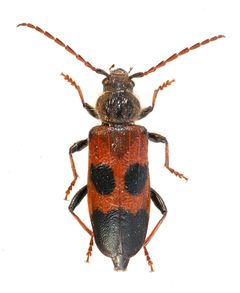
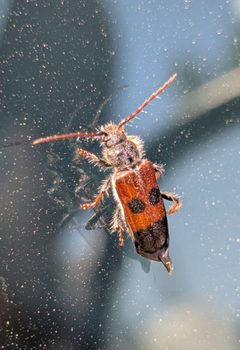
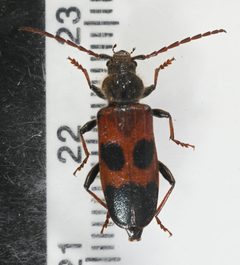
Pronunciation
How to pronounce Semanotus: /sɛˈmænətəs/
These audio files are automatically generated. While they are not always 100% accurate, they are a good starting point.
Identification
Semanotus are cerambycid beetles typically associated with coniferous . Specific diagnostic features for the require examination of morphological characters such as length, pronotum shape, and elytral patterning, though these traits vary among species. Species-level identification often relies on host associations and geographic distribution in combination with morphological examination.
Images
Habitat
Coniferous forests and woodlands. are associated with various conifer including juniper (Juniperus), fir (Abies), cedar (Thuja/Cedrus), cryptomeria (Cryptomeria), cypress (Taxodium/Platycladus), and pine (Pinus). range from lowland to montane elevations depending on species.
Distribution
Holarctic distribution with records from North America, Europe, Asia, and North Africa. Specific have more restricted ranges: S. juniperi in southwestern United States (Arizona, Utah, Nevada); S. litigiosus in western North America; S. japonicus in Japan; S. bifasciatus in Asia; S. algiricus in North Africa; S. russicus in Europe and Asia.
Seasonality
activity varies by and climate. S. litigiosus adults emerge March–April after in pupal chambers. S. japonicus adult period occurs in spring and early summer, with timing influenced by post-hibernation temperatures. S. bifasciatus activity patterns correspond to regional climate conditions.
Diet
Phloem and sapwood of coniferous trees. Larvae feed internally, excavating galleries in phloem and later entering sapwood. Specific associations documented: S. juniperi in large limbs of Utah juniper (Juniperus osteosperma); S. litigiosus in white fir (Abies concolor) and other conifers; S. japonicus in Japanese cedar (Cryptomeria japonica) and cypress; S. bifasciatus in Platycladus and Taxodium hybrids.
Host Associations
- Juniperus osteosperma (Utah juniper) - S. juniperi breeds in large limbs
- Abies concolor (white fir) - S. litigiosus primary
- Cryptomeria japonica (Japanese cedar/sugi) - S. japonicus primary
- Platycladus orientalis - S. bifasciatus
- Taxodium hybrid 'Zhongshanshan' - S. bifasciatus causes dieback
- Pinus ponderosa (ponderosa pine) - S. amethystinus
- Thuja/Cedrus (cedar) - S. amethystinus 'Amethyst Cedar Borer'
- Sclerodermus guani - natural enemy of S. bifasciatus, reduces suitable area by up to 40%
- Woodpeckers - Documented of S. litigiosus
- Ostomid beetle - of S. litigiosus larvae
- Braconid wasp - of S. litigiosus
- Fusarium species - / associateSix Fusarium associated with S. bifasciatus galleries, including two newly described species (F. semanoti, F. taxodii)
Life Cycle
Complete with variable timing by . S. litigiosus: laid in bark crevices in early spring, incubation 10–30 days; larvae excavate winding phloem galleries until midsummer, then enter sapwood and bore up to 7.6 cm into wood to construct pupal chambers; 2–4 weeks in fall; form by September and overwinter in pupal chambers; March–April. S. bifasciatus: eight larval instars distinguished by capsule and pronotum width measurements.
Behavior
are somewhat sluggish with limited between-tree movement, resulting in contagious spatial distribution patterns. S. japonicus males locate females using olfactory cues effective at close range; copulation is elicited by a stable, non-volatile contact on the female body surface. Males attempt copulation with inanimate objects bearing female chemical cues even after 7 days. removal and blinding delay copulation in males but not females. includes small- at cool temperatures and large-scale at warm temperatures; mean dispersal distances of 9.2 m (males) and 16.3 m (females) with maximum recorded distances of 79.5 m and 149.5 m respectively.
Ecological Role
Primary consumer and wood-boring herbivore of conifers. Larval tunneling causes structural degradation of timber and tree mortality in stressed . are influenced by availability of host material (particularly windthrown or stressed trees) and pressure from natural enemies. S. bifasciatus is considered a pest in China posing significant threat to forest ecological security. Some may fungal (Fusarium spp.) that contribute to tree dieback.
Human Relevance
Several are significant forest and timber pests. S. litigiosus causes serious degrade in lumber manufactured from windthrown white fir. S. bifasciatus is a wood-boring pest in China causing severe damage to cypress trees and Taxodium hybrid plantings. S. japonicus is a major pest of Japanese cedar plantations. S. amethystinus (Amethyst Cedar Borer) is encountered in urban and suburban settings in North America. S. juniperi is sought after by collectors due to its rarity. Control strategies include using such as Sclerodermus guani.
Similar Taxa
- CallidiumBoth are cerambycid with conifer-associated wood-boring ; Callidium species typically have different antennal proportions and elytral sculpturing, and often infest smaller branches rather than main limbs
- MonochamusBoth are large cerambycid borers of conifers; Monochamus are generally larger with more robust bodies and different antennal segment ratios, and often have distinct elytral patterns
- AtimiaBoth include juniper-associated in southwestern North America; Atimia species are typically smaller with different pronotal and antennal characteristics
More Details
Conservation status
S. juniperi appears to be genuinely rare with very few documented collections; specificity (large-diameter Utah juniper limbs) and limited geographic range may contribute to rarity
Research significance
S. japonicus has been extensively studied as a model for cerambycid mating and chemical , particularly regarding contact function
Climate change implications
MaxEnt modeling for S. bifasciatus predicts northward range expansion with climate change; suitable area nearly doubles when plant availability is incorporated into models
Sources and further reading
- BugGuide
- Wikipedia
- GBIF taxonomy match
- iNaturalist taxon
- NCBI Taxonomy
- Catalogue of Life
- Chrysididae | Beetles In The Bush
- Bug Eric: From My Inbox
- Mating Behavior of the Cryptomeria Bark Borer, Semanotus japonicus LACORDAIRE(Coleoptera:Cerambycidae)
- THE BIOLOGY OF THE FIR TREE BORER, SEMANOTUS LITIGIOSUS (COLEOPTERA: CERAMBYCIDAE), IN CALIFORNIA
- Integrating host plants and a key natural enemy into MaxEnt improves global suitability predictions for Semanotus bifasciatus
- Spatial Distribution Pattern of the Sugi Bark Borer, Semanotus japonicus LACORDAIRE (Coleoptera : Cerambycidae), on Japanese Cedar Trees
- Determination of Larval Instars of Semanotus bifasciatus (Coleoptera: Cerambycidae) Based on Frequency Distributions of Morphological Variables
- Adult populations of the sugi bark borer, Semanotus japonicus Lacordaire (Coleoptera: Cerambycidae), in Japanese cedar stands: Population parameters, dispersal, and spatial distribution
- Comparison of host volatiles under different physiological states and electroantennogram responses of Semanotus bifasciatus (Motschulsky) to these volatiles
- Function of Contact Pheromone in the Mating Behavior of the Cryptomeria Bark Borer, Semanotus japonicus LACORDAIRE(Coleoptera:Cerambycidae)
- Two new species and four new host records of Fusarium species (Nectriaceae, Hypocreales) associated with Semanotus bifasciatus causing Taxodium hybrid ‘Zhongshanshan’ dieback
- Differential Host Residence of Adult Cryptomeria Bark Borer,Semanotus japonicusLacordaire (Coleoptera: Cerambycidae), in Relation to Tree Size of Japanese Cedar,Cryptomeria japonicaD. Don
- An Outbreak of the Cryptomeria Bark Borer, Semanotus japonicus LACORDAIRE(Coleoptera:Cerambycidae), in a Young Japanese Cedar(Cryptomeria japonica D.DON)Plantation : II. Between-Tree Distribution of Adult Emergence Holes and Its Relation to Tree Size