
Phymatodes maculicollis
LeConte, 1878
Phymatodes maculicollis is a of longhorn beetle in the Cerambycidae, described by LeConte in 1878. The species belongs to the Phymatodes, which is most diverse in western North America and contains approximately 26 recognized species on the continent. Like other members of its genus, P. maculicollis is associated with woody plants, though specific host associations for this species remain poorly documented. The species has been recorded across a broad geographic range in North America, from western Canada through the western United States.
Pronunciation
How to pronounce Phymatodes maculicollis: /faɪˈmætəˌdiːz ˌmækjʊlɪˈkɒlɪs/
These audio files are automatically generated. While they are not always 100% accurate, they are a good starting point.
Identification
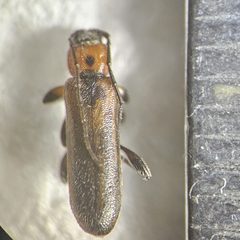
Phymatodes maculicollis can be distinguished from other North American Phymatodes by the combination of its maculate (spotted) pronotum and overall coloration pattern. The specific epithet 'maculicollis' refers to the spotted or marked neck (pronotum). Within the , it differs from P. aeneus, P. ater, and P. nigrescens by its distinct pronotal patterning. It can be separated from P. obliquus and P. decussatus by differences in elytral and coloration. Accurate identification requires examination of the type of pronotal and elytral maculation, as well as antennal proportions in males. For definitive identification, comparison with or use of the diagnostic key provided by Swift & Ray (2010) is recommended.
Images
Habitat
The occurs in forested and woodland where its plants grow. Based on the of related Phymatodes species, it likely inhabits areas with dead or dying woody vegetation, as larvae of this typically develop in dead branches and twigs. Specific microhabitat preferences for P. maculicollis have not been documented.
Distribution
Phymatodes maculicollis has been recorded from western North America, including the Canadian provinces of Alberta, British Columbia, New Brunswick, and Québec, as well as the western United States. The appears to have a transcontinental distribution in northern and western portions of the continent, though records are sparse and its full range may be incompletely known.
Life Cycle
As with other Cerambycidae, P. maculicollis undergoes complete with , larval, pupal, and stages. Larvae of Phymatodes are wood-borers that develop in dead branches and twigs of their plants. The larval period likely spans one to multiple years depending on environmental conditions, with adults emerging and being active during the warmer months. Specific details of the for P. maculicollis have not been published.
Behavior
are likely or and may be found on plants or attracted to light. Like other Phymatodes , adults probably do not feed extensively, as is common in many cerambycine beetles. Larval consists of tunneling in dead wood, creating galleries as they feed.
Ecological Role
As a wood-boring , the larvae contribute to the decomposition of dead woody material, playing a role in nutrient cycling within forest . The also serves as a potential food source for including woodpeckers and other insectivorous animals that excavate dead wood.
Human Relevance
No significant direct economic impact has been documented for this . It is not known to be a pest of living trees or commercial timber. The species is of interest to coleopterists and naturalists studying the diversity of North American Cerambycidae.
Similar Taxa
- Phymatodes obliquusFormerly confused with P. decussatus; both share similar overall body form and western North American distribution, but differ in pronotal and elytral and specific associations (P. obliquus with oak, P. decussatus with walnut)
- Phymatodes decussatusHistorically misapplied name for P. obliquus; true P. decussatus is associated with walnut (Juglans) rather than oak and has distinct type-based morphological differences in pronotal shape and elytral pattern
- Phymatodes aeneusOverlaps in distribution and shares metallic coloration, but lacks the distinct pronotal maculation characteristic of P. maculicollis
- Phymatodes aterSimilar size and body form, but uniformly dark coloration without the spotted pronotum of P. maculicollis
More Details
Taxonomic History
The Phymatodes has undergone significant nomenclatural revision. Swift & Ray (2010) published important changes affecting North American , including synonymies of several species and . Phymatodes maculicollis was not directly affected by these changes but remains one of the less commonly encountered species in the genus. The species was described by John Lawrence LeConte in 1878 based on specimens from western North America.
Collection and Study
This is considered elusive and is poorly represented in collections. Specimens have been obtained through general collecting, beating of vegetation, and attraction to light. Rearing from plants, a productive method for other Phymatodes species, has not been documented for P. maculicollis specifically.
Sources and further reading
- BugGuide
- Wikipedia
- GBIF taxonomy match
- iNaturalist taxon
- NCBI Taxonomy
- Catalogue of Life
- Meloidae Holdings | Entomology Research Museum
- Nomenclatural changes in Phymatodes | Beetles In The Bush
- Glowing on the Golf Course: Fluorescent Imaging Reveals Turfgrass Pest's Most Active Period
- Cerambycidae | Beetles In The Bush | Page 10
- October | 2021 | Beetles In The Bush
- Missouri | Beetles In The Bush | Page 5