
Callidiellum
Linsley, 1940
Species Guides
3- Callidiellum cupressi(cypress longhorn beetle)
- Callidiellum rufipenne(Japanese Cedar Longhorned Beetle)
- Callidiellum villosulum
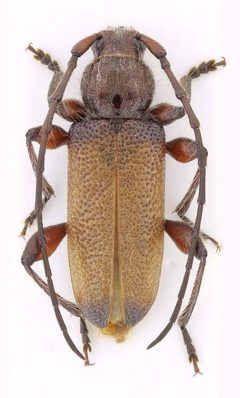
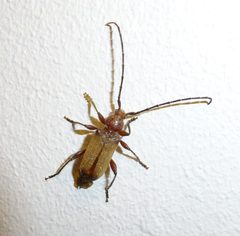
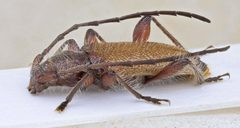
Callidiellum is a of longhorn beetles (Cerambycidae) in the tribe Callidiini. The genus contains at least three described , including the well-studied Callidiellum rufipenne, an Asian cedar borer established in North America. Members of this genus are wood-borers specializing on living conifers in the Cupressaceae.
Pronunciation
How to pronounce Callidiellum: /kælɪˈdiːləm/
These audio files are automatically generated. While they are not always 100% accurate, they are a good starting point.
Identification
Callidiellum are small to medium-sized cerambycids. C. rufipenne have reddish-brown with darker bases, giving a two-toned appearance. The is distinguished from related Callidiini by genitalic and antennal characteristics, though precise diagnostic features require examination.
Images
Habitat
Associated with living coniferous trees, particularly Cupressaceae. C. rufipenne occurs in urban and suburban areas with planted ornamental cedar in its introduced North American range.
Distribution
Native to Asia (China, Japan, Korean Peninsula, Taiwan, Russian Far East). C. rufipenne introduced and established in eastern North America (USA: Connecticut, Massachusetts, New Jersey, New York, North Carolina, Pennsylvania, Rhode Island, Washington; Canada: British Columbia), with additional records from Italy, Argentina, New Zealand, and Puerto Rico.
Diet
Larvae bore into and feed on the wood of living trees. do not feed on wood; feeding habits of adults are not well documented.
Host Associations
- Cupressaceae - primary living conifers
- Juniperus virginiana - eastern red cedar
- Juniperus chinensis - Chinese juniper
- Juniperus scopulorum - Rocky Mountain juniper
- Thuja occidentalis - northern white cedar/arborvitae
- Thuja orientalis - oriental arborvitae
- Chamaecyparis pisifera - Sawara falsecypress
- Cupressus - cypress
- Calocedrus decurrens - incense cedar
- Cryptomeria japonica - Japanese cedar
- Sequoia sempervirens - coast redwood
- Sequoiadendron giganteum - giant sequoia
- Taxodium distichum - bald cypress
- Platycladus orientalis - oriental arborvitae
Life Cycle
laid on or in bark. Larvae bore into wood and develop within living host tissue. occurs within the wood. emerge through exit holes. C. rufipenne has been observed to complete development in living trees rather than dead wood.
Behavior
Wood-boring habit targeting living trees. C. rufipenne exhibits selection influenced by bark water content of potential hosts. of C. villosulum show in palpal , with females having more developed sensilla basiconica type IV, sensilla campaniformia, and sensilla chaetica type II, potentially related to oviposition behavior.
Ecological Role
C. rufipenne acts as a pest of ornamental and native Cupressaceae in its introduced range. Native Labena grallator (Ichneumonidae) has been documented attacking C. rufipenne in North America, suggesting some potential.
Human Relevance
C. rufipenne is an economically significant pest damaging ornamental and landscape conifers. selection studies on bark water content have been conducted to inform management. studies on C. villosulum aim to inform control method design.
Similar Taxa
- CallidiumBoth in tribe Callidiini; Callidiellum distinguished by genitalic and antennal
- PhytoeciaSimilar small cerambycids; Callidiellum typically more robust with different antennal proportions
Sources and further reading
- BugGuide
- Wikipedia
- GBIF taxonomy match
- iNaturalist taxon
- NCBI Taxonomy
- Catalogue of Life
- Callidiellum rufipenne . [Distribution Map].
- Labena grallator (Say) (Hymenoptera: Ichneumonidae) Found Associated with the Non-Native Callidiellum rufipenne (Motschulsky) (Coleoptera: Cerambycidae)
- Distribution and Hosts of Callidiellum rufipenne (Coleoptera: Cerambycidae), an Asian Cedar Borer Established in the Eastern United States
- Scanning electron microscopy of sensilla on the labial and maxillary palps of adult Callidiellum villosulum Fairmaire (Coleoptera: Cerambycidae)
- Distribution and Hosts of <I>Callidiellum rufipenne</I> (Coleoptera: Cerambycidae), an Asian Cedar Borer Established in the Eastern United States
- Host selection of small cedar longicorn beetle,Callidiellum rufipenne(Coleoptera:Cerambycidae), on Japanese cedar,Cryptomeria japonica, in terms of bark water content of host trees