
Callidiellum villosulum
(Fairmaire, 1900)
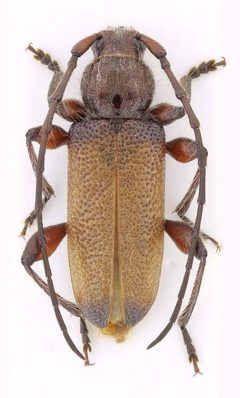
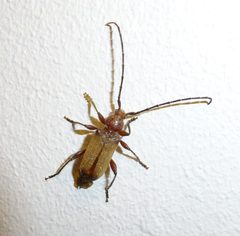
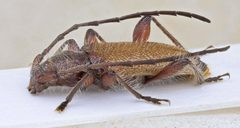
A small longhorn beetle (Cerambycidae: Cerambycinae: Callidiini) characterized by in mouthpart . females possess larger labial and maxillary palps with more developed basiconica IV, sensilla campaniformia, and sensilla chaetica II, structures associated with oviposition site selection. Males exhibit more developed sensilla basiconica I, potentially involved in mate recognition. The has been subject to detailed scanning electron microscopy studies of its chemosensory and mechanosensory mouthpart structures.
Pronunciation
How to pronounce Callidiellum villosulum: /kælɪˈdiːələm vɪləˈsuːləm/
These audio files are automatically generated. While they are not always 100% accurate, they are a good starting point.
Identification
Distinguishable from congeneric by detailed examination of palp patterns, though specific diagnostic features require microscopic analysis. in palp size and sensilla development is pronounced and may aid in sex determination. The combination of three-segmented labial palps and four-segmented maxillary palps with the described sensilla complement is characteristic. Differentiation from other Callidiellum species requires comparison of external and genitalia; consult specialized Cerambycidae literature.
Images
Appearance
exhibit in mouthpart dimensions. Labial palps consist of three segments; maxillary palps consist of four segments. Female palps are significantly larger in both length and width than male palps. Four types of are present on both palp types: sensilla basiconica (types I-IV), sensilla chaetica (types I-II), sensilla placodea, and sensilla campaniformia. General body typical of Callidiini: small to medium cerambycids with cylindrical body form.
Distribution
Documented from Australia and Belgium (GBIF records include ABSENT designations for Belgium, indicating potential misidentifications or historical records rather than established ). Native range appears to include regions where the has been recorded as present, though precise distribution requires verification.
Behavior
involves selection and oviposition, with female development suggesting tactile and chemosensory evaluation of substrate suitability. Male sensilla development patterns suggest involvement in mate location or recognition. Maxillary palps appear to play a more significant sensory role than labial palps based on higher sensilla counts.
Human Relevance
Identified as a pest in the context of behavioral control research. has been studied to inform targeted pest management strategies, with potential for developing interference-based control methods targeting selection or mating .
Similar Taxa
- Other Callidiellum speciesRequire microscopic examination of genitalia and detailed external for reliable separation; palp patterns may provide additional diagnostic characters.
- Callidiini tribe membersShare general body plan and size; precise identification relies on antennal, pronotal, and elytral details combined with genitalic examination.
More Details
Sensilla nomenclature
The study establishing palp uses standardized terminology: SB (sensilla basiconica), SCh (sensilla chaetica), SP (sensilla placodea), and SCa (sensilla campaniformia). Type numbers indicate morphological variants within these categories.