
Polycesta californica
LeConte, 1857
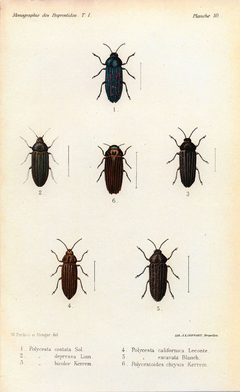
Polycesta californica is a of metallic wood-boring beetle in the Buprestidae, first described by LeConte in 1857. It belongs to the subgenus Tularensia within the Polycesta. The species is native to western North America, with records from California and surrounding regions. As a member of the jewel beetle family, it exhibits the characteristic metallic coloration typical of Buprestidae.
Pronunciation
How to pronounce Polycesta californica: //pɒlɪˈsɛstə kælɪˈfɔːrnɪkə//
These audio files are automatically generated. While they are not always 100% accurate, they are a good starting point.
Identification
Within the Polycesta, P. californica can be distinguished from by its placement in the subgenus Tularensia. The is smaller than many other North American Polycesta species. likely exhibit metallic coloration typical of the , though specific diagnostic features require examination of morphological characters described in the original species description.
Images
Habitat
The has been reared from dead wood, indicating association with woody vegetation. It has been documented from valley oak (Quercus lobata) in California, where it was found in association with the Acanthochalcis unispinosa. The species occurs in oak woodland and similar in western North America.
Distribution
Western North America, primarily California. Documented from valley oak in California. The name reflects its California type locality.
Diet
Larvae are wood-borers, feeding within dead branches of trees. Documented host plants include Quercus lobata (valley oak). The larval diet consists of dead wood tissue.
Host Associations
- Quercus lobata - larval valley oak; larvae develop in dead wood
Life Cycle
Complete with , larva, pupa, and stages. Larvae are wood-boring and develop within dead branches of trees. Adults emerge from wood and are active during the warmer months.
Behavior
are likely and active on warm days, typical of Buprestidae. Larvae bore in dead wood of trees. The has been reared from field-collected dead wood, indicating larvae can be present in dead branches that appear intact.
Ecological Role
As a wood-boring , larvae contribute to nutrient cycling by breaking down dead wood. The serves as a for , specifically Acanthochalcis unispinosa (Chalcididae), which has been reared from wood infested with P. californica.
Similar Taxa
- Polycesta cazieriBoth belong to subgenus Tularensia and share similar size and preferences; distinguished by specific morphological characters
- Polycesta arizonicaOccurs in similar western North American ; distinguished by subgeneric placement and morphological details
More Details
Parasitoid associations
Polycesta californica has been documented as a for the chalcidid Acanthochalcis unispinosa, one of the few recorded associations for this . This wasp is larger than the related A. nigricans and lacks the white abdominal pubescent patches seen in that species.
Taxonomic placement
The is classified in the subgenus Tularensia within Polycesta, a grouping established by Nelson in 1997. This subgenus includes several small western North American species.
Sources and further reading
- BugGuide
- Wikipedia
- GBIF taxonomy match
- iNaturalist taxon
- Catalogue of Life
- The Big 43: The California Native Plants, Plus One, Studied in UC Davis Research | Bug Squad
- Bohart Museum: Learn about California's State Insect on UC Davis Picnic Day | Bug Squad
- A chalcidid jewel beetle parasitoid wasp | Beetles In The Bush
- insect collection | Beetles In The Bush | Page 3
- Winter Botany Quiz #6 – answers and a checklist | Beetles In The Bush
- Nevada | Beetles In The Bush | Page 3