
Acmaeodera diffusa
Barr, 1969
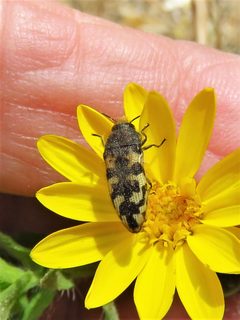
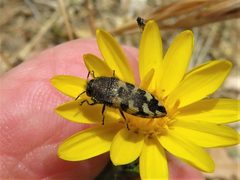
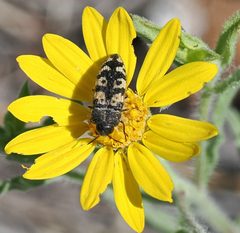
Acmaeodera diffusa is a metallic wood-boring beetle in the Buprestidae, described by Barr in 1969. The is known from western North America, with records from Utah and surrounding regions. are flower visitors, frequently collected from blooms of pricklypear cacti (Opuntia), globemallow (Sphaeralcea), and other desert forbs. Like other Acmaeodera species, larvae likely develop in dead or dying woody plants, though specific associations remain incompletely documented.
Pronunciation
How to pronounce Acmaeodera diffusa: /ækˌmiːoʊˈdɛrə dɪˈfjuːsə/
These audio files are automatically generated. While they are not always 100% accurate, they are a good starting point.
Images
Habitat
Pinyon-juniper woodland, sand dune with scattered vegetation, and shortgrass prairie with gypsum or clay soils. are associated with flowering plants in these open, arid to semi-arid environments.
Distribution
Western North America; recorded from Utah (Kane County, Washington County), with range likely extending to adjacent states. GBIF records indicate presence in the .
Seasonality
active in late June through July based on field observations. Peak activity coincides with summer blooming periods of flowers.
Diet
feed on pollen and nectar of flowering plants. Observed flower include Sphaeralcea parvifolia, Sphaeralcea grossulariifolia, Hymenopappus filifolius, Opuntia aurea, Opuntia woodsii, Opuntia camanchica, Opuntia fragilis, Acmispon wrightii, Penstemon palmeri, and Melampodium leucanthum. Larval diet unknown but presumed to involve wood of dead or dying trees and shrubs.
Host Associations
- Sphaeralcea parvifolia - food sourceflower
- Sphaeralcea grossulariifolia - food sourceflower
- Hymenopappus filifolius - food sourceflower
- Opuntia aurea - food sourceflower ; both yellow and pink forms
- Opuntia woodsii - food sourceflower
- Opuntia camanchica - food sourceflower
- Opuntia fragilis - food sourceflower
- Acmispon wrightii - food sourceflower
- Penstemon palmeri - food sourceflower
- Melampodium leucanthum - food sourceflower
Behavior
are flower visitors, frequently found resting within cactus blooms during evening hours. They have been observed bedding down in spent flowers of Opuntia aurea. Adults are attracted to white bottle traps placed near flowering vegetation. activity on tree trunks not documented for this .
Ecological Role
flower visitation contributes to pollination of desert forbs and cacti. Larval wood-boring habit contributes to nutrient cycling in dead woody vegetation.
Human Relevance
Collected by entomologists for scientific study. readily captured using aerial nets at flowers or by beating dead branches. No known economic importance.
Similar Taxa
- Acmaeodera bowditchiSimilar size and flower-visiting habit; often found on same flowers. Distinguished by elytral coloration and maculation pattern.
- Acmaeodera immaculataOccurs sympatrically and shares flower ; distinguished by lack of elytral maculation.
- Acmaeodera ligulataSimilar and flower associations; distinguished by body shape and elytral pattern.
- Acmaeodera knowltoniOverlapping range in Utah; distinguished by larger size and orange versus yellow elytral flecking.
- Acmaeodera rubronotataSimilar size and appearance; distinguished by elytral color pattern with red markings.
More Details
Collection notes
Field observations indicate this is frequently encountered in mixed-species with other Acmaeodera on shared flower . Multiple specimens often collected from single flowering plants. White bottle traps effective for sampling when placed near blooming vegetation.
Taxonomic note
Described by William F. Barr in 1969. Part of the diverse Acmaeodera fauna of western North America, a containing over 140 in the region.