
Acmaeodera bowditchi
Fall, 1901
Acmaeodera bowditchi is a of metallic wood-boring beetle in the Buprestidae. It is found in North America, with documented records from the southwestern United States including Utah, Arizona, and New Mexico. have been observed visiting flowers of various plant species, particularly in pinyon-juniper woodland and related . The species was described by Fall in 1901.
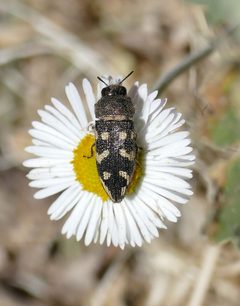
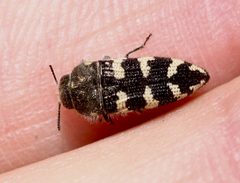
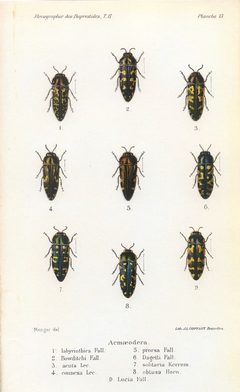
Pronunciation
How to pronounce Acmaeodera bowditchi: /ˌækmiːoʊˈdɛrə ˈbaʊdɪtʃi/
These audio files are automatically generated. While they are not always 100% accurate, they are a good starting point.
Identification
are small to medium-sized metallic wood-boring beetles typical of the Acmaeodera. Specific diagnostic features distinguishing A. bowditchi from are not documented in available sources. The occurs sympatrically with multiple other Acmaeodera species in its range, including A. diffusa, A. ligulata, A. angelica, A. knowltoni, A. perlanosa, A. pubiventris lanata, and A. quadrivittatoides, with which it has been collected on shared flower .
Images
Habitat
Pinyon-juniper woodland, Gambel oak woodland, and associated transitional . have been collected in areas with abundant flowering plants, particularly where pricklypear cacti (Opuntia spp.), globemallows (Sphaeralcea spp.), and other herbaceous flowers are present.
Distribution
North America; documented from southwestern United States including Utah (Washington County, Kane County), Arizona (Coconino County), and New Mexico. GBIF records indicate presence in the Nearctic region.
Seasonality
activity has been documented from late June through at least mid-July. Field records indicate peak activity during morning and early afternoon hours when flowers are open and accessible.
Diet
feed on pollen and nectar of various flowering plants. Documented flower include Opuntia fragilis (brittle pricklypear), Opuntia woodsii, Opuntia camanchica, Opuntia aurea, Sphaeralcea grossulariifolia (gooseberryleaf globemallow), Heliomeris multiflora (showy goldeneye), Eriodictyon angustifolium, Tetraneuris acaulis (stemless four-nerved daisy), Penstemon palmeri, Acmispon wrightii, and Melampodium leucanthum. Larval diet unknown; presumably feeds on roots or wood of host plants as is typical for the .
Host Associations
- Opuntia fragilis - flower visitorbrittle pricklypear cactus
- Opuntia woodsii - flower visitorWoods' pricklypear cactus
- Opuntia camanchica - flower visitortulip pricklypear cactus
- Opuntia aurea - flower visitorgolden pricklypear cactus
- Sphaeralcea grossulariifolia - flower visitorgooseberryleaf globemallow
- Heliomeris multiflora - flower visitorshowy goldeneye
- Eriodictyon angustifolium - flower visitornarrowleaf yerba santa
- Tetraneuris acaulis - flower visitorstemless four-nerved daisy
- Penstemon palmeri - flower visitorPalmer's penstemon
- Acmispon wrightii - flower visitorWright's deervetch
- Melampodium leucanthum - flower visitorblackfoot daisy
Life Cycle
Complete with , larva, pupa, and stages. Larval undescribed; presumably subterranean or wood-boring as in related Acmaeodera . Adults are and active during daylight hours, particularly associated with flowering plants.
Behavior
are flower visitors, frequently found on open flowers of herbaceous plants and cacti. They have been observed sharing flower with numerous other Acmaeodera and with beetles of other (particularly Cleridae such as Trichodes ornatus). Adults are capable of and readily move between flowering plants.
Ecological Role
function as of visited flowers. As larvae, presumably contribute to nutrient cycling through wood or root feeding, though specific ecological impacts are undocumented.
Similar Taxa
- Acmaeodera diffusaSympatric and frequently collected on identical flower ; distinguished by subtle morphological differences in elytral maculation and body proportions
- Acmaeodera ligulataSympatric in pinyon-juniper and oak woodland ; shares flower particularly on Opuntia
- Acmaeodera angelicaCollected on shared flower including Eriodictyon angustifolium; distinguished by elytral pattern
- Acmaeodera knowltoniSympatric and found on overlapping flower ; A. knowltoni is larger with uniformly orange rather than yellow elytral flecks
- Acmaeodera quadrivittatoidesCollected on same Opuntia flower ; distinguished by elytral pattern with four vittae