
Agrilus
jewel beetles, metallic woodboring beetles
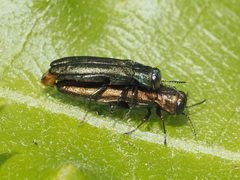
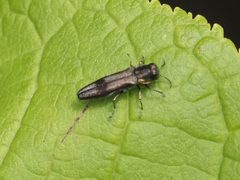
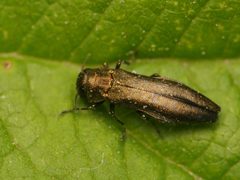
Agrilus is a hyperdiverse of jewel beetles (Buprestidae) containing nearly 4,000 described and potentially representing the largest genus in the animal kingdom. Species are primarily twig and branch borers, with larvae developing in recently dead wood, though notable exceptions attack living trees. The genus exhibits remarkable specificity ranging from highly monophagous to oligophagous associations, exclusively with angiosperms—no species are known to utilize conifers. are typically found on foliage of larval hosts rather than flowers, with occurring in some species.
Pronunciation
How to pronounce Agrilus: /əˈɡraɪləs ˈspiːsiːz eɪ/
These audio files are automatically generated. While they are not always 100% accurate, they are a good starting point.
Identification
Identification to within Agrilus requires examination of male genitalia for definitive determination, as many species are morphologically cryptic. Some species groups exhibit distinctive color patterns, such as black with red pronota (e.g., A. audax, A. vittaticollis, A. fuscipennis, A. benjamini), or purplish-red ground coloration with complex golden setal patterns on elytra (e.g., A. turnbowi, A. andersoni, A. howdenorum). characters may provide diagnostic separation: A. audax possesses a with sides not bent downward to sharp points (in contrast to A. vittaticollis), a moderately depressed and uniformly pubescent (versus deeply depressed with restricted to lower half in A. benjamini), and males exhibit a deep, smooth, elongate depression on sternite (obsolete in A. benjamini). occurs in A. walsinghami: males are bronzy-brown with coppery reflections on and pronotum and brassy elytra with purplish tints, while females are larger, more robust, and uniformly blue to greenish blue above.
Images
Habitat
span diverse environments across all continents except Antarctica, with highest diversity in tropical and warm temperate regions. occupy forests, woodlands, and shrublands where plants occur. Larval development occurs in woody substrates: primarily dead twigs and branches, though some species mine living tree trunks, crowns, and main roots. Late-season activity occurs in western North American aridlands, particularly associated with woody Asteraceae such as rabbitbrush in response to monsoon rainfall patterns.
Distribution
distribution excluding Antarctica. In North America, occurs from Canada through the United States to Mexico, with particular diversity in the southwestern U.S. and Mexico. Western U.S. records include British Columbia to Baja California and east to Colorado. Midwestern and eastern records include Texas, Oklahoma, Missouri, Illinois, Ohio, Kansas, and Nevada.
Seasonality
activity predominantly spring and early summer across most of range. Late summer and early fall activity documented in western aridlands, particularly July through September for A. walsinghami. Bimodal activity patterns occur in south Texas due to spring and fall rains. Seasonal timing varies with plant and regional precipitation patterns.
Diet
Larvae feed on wood of plants, primarily in dead twigs and branches. feed on foliage of larval hosts; some feed on flower petals.
Host Associations
- Ulmus rubra - larval slippery elm, living wind-thrown branches, recorded for A. audax
- Quercus macrocarpa - larval bur oak, beaten from foliage, primary for A. audax
- Diospyros virginiana - larval persimmon, larval for A. fuscipennis
- Amelanchier - larval serviceberry, for A. vittaticollis
- Hibiscus - larval wild hibiscus, crown of living plants, for A. concinnus
- Sphaeralcea - suspected larval for A. malvastri, unconfirmed
- Callirhoe involucrata - larval winecup, presumed for A. muticus, feed on petals
- Eriogonum - larval confirmed for A. blandus, visit flowers
- Ericameria nauseosa - presumed larval gray rabbitbrush, exclusively associated, unconfirmed for A. walsinghami
- Phoradendron - larval mistletoe, hemiparasitic on mesquite and other woody , recorded for A. turnbowi, A. andersoni, A. howdenorum
- Prosopis glandulosa - indirect mesquite, for mistletoe that supports A. turnbowi
Life Cycle
Larval development occurs within woody tissue. Most develop in recently dead twigs and branches; some species mine living tree trunks, crowns, and main roots. occurs within the larval gallery. emerge and are typically found on foliage of larval hosts. Species developing in living hosts are more difficult to rear than those in dead wood, as infested material cannot simply be collected and held for .
Behavior
are most commonly encountered on foliage of larval plants, typically not visiting flowers (unlike related Acmaeodera and Anthaxia). Exceptions include A. muticus, found almost exclusively in flowers of winecup where adults feed on petals and mate, and A. blandus, frequently encountered on flowers of Eriogonum. Adults of some exhibit escape when disturbed. Late-season species in western aridlands demonstrate activity patterns synchronized with monsoon rainfall.
Ecological Role
Larvae function as wood decomposers in dead branches and twigs, contributing to nutrient cycling. attacking living trees may act as secondary pests, exploiting trees under biotic or abiotic stress. Some species serve as indicators of plant distribution and quality. No known associations with conifers have limited expansion into forest .
Human Relevance
Several are significant economic pests in forest and ornamental landscapes: Agrilus anxius (bronze birch borer), A. bilineatus (twolined chestnut borer), and A. planipennis (emerald ash borer). The latter, an in North America, has caused extensive mortality of ash trees. Most pest species have been facilitated by human activity—through introduction of species or of exotic plants. The is popular among insect collectors due to metallic coloration, though many species are small and cryptically colored compared to other Buprestidae.
Similar Taxa
- Acmaeodera routinely visit flowers and exhibit aposematic coloration mimicking stinging Hymenoptera; distinguished from Agrilus by flower-visiting and elytral markings
- Anthaxia regularly visit flowers; distinguished by different associations and morphological characters
- Agrilaxia occasionally visit flowers; smaller and less speciose with different morphological features
- ParagrilusClose relative with associated with Malvaceae; normally found on foliage rather than flowers
More Details
Taxonomic challenges
Hyperdiversity within Agrilus has created a taxonomic quagmire with difficult-to-define limits. Many species are hardly distinguishable without examination of male genitalia. The remains woefully understudied, with Fisher's 1928 revision still the only comprehensive resource for North American species despite being outdated.
Collection history
The has been extensively collected by notable entomologists including Josef N. Knull, who described 233 and of beetles during his career at The Ohio State University (1934-1962). Misidentifications occur even among expert collectors due to cryptic ; Knull himself misidentified specimens of A. audax as A. vittaticollis.
Research opportunities
relationships remain poorly documented for most . The observation that 'rare' species are often simply difficult to locate has been demonstrated by recent discoveries, such as A. concinnus becoming more frequently encountered once its association with living Hibiscus crowns and late-season was understood.
Sources and further reading
- BugGuide
- Two new species of Agrilus from Mexico | Beetles In The Bush
- GBCT Beetle #2: Agrilus walsinghami | Beetles In The Bush
- Agrilus fuscipennis on Persimmon | Beetles In The Bush
- A flower visiting jewel beetle that is not an Acmaeodera | Beetles In The Bush
- Josef Knull was wrong! | Beetles In The Bush