
Paragrilus
Saunders, 1871
Species Guides
2- Paragrilus rugatulus(Metallic Woodborer)
- Paragrilus tenuis
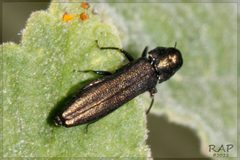
Paragrilus is a of jewel beetles ( Buprestidae) in the Agrilinae, native to the Americas. The genus contains approximately 70 described distributed across North, Central, and South America, with four species occurring in the United States. Species are generally small, dark-colored beetles with reduced metallic luster compared to many other buprestids. They are distinguished from the related and more diverse genus Agrilus by their , which can be received into grooves along the sides of the pronotum.
Pronunciation
How to pronounce Paragrilus: //ˌpæɹəˈɡraɪləs//
These audio files are automatically generated. While they are not always 100% accurate, they are a good starting point.
Identification
Distinguished from the closely related Agrilus by the presence of antennal grooves () on the lateral margins of the pronotum, into which the can be tucked. -level identification requires examination of subtle morphological characters including pronotal , elytral , and aedeagal structure; Hespenheide (2002) provides a key to North and Central American species.
Images
Habitat
Associated with herbaceous vegetation, particularly plants in the order Malvales. found on foliage of plants. Occurs in natural including wetlands and lowland areas where host plants grow.
Distribution
Native to the Americas. Occurs from the United States south through Central America to South America. In the United States, four are recorded: P. tenuis (eastern U.S., New York to Florida, west to Missouri and Mississippi), P. burkei, P. lesueuri, and P. rugatulus. Colombian records confirmed.
Seasonality
active during spring and early summer; P. tenuis observed in association with blooming Hibiscus in July and August.
Host Associations
- Hibiscus moscheutos - confirmed larval Includes lasiocarpos; P. tenuis reared from this
- Hibiscus laevis - association collected on this plant but not yet reared
- Sida - associationFour in the P. rugatulus group commonly found on this
- Malvales - order-level associationAll known belong to Malvaceae, Sterculiaceae, and Tiliaceae within this order
Life Cycle
Behavior
perch on terminal leaves of plants. Extremely wary and quick to take when disturbed, making observation and photography challenging. Adults observed feeding on upper leaf surfaces and mating on host plant foliage.
Ecological Role
Herbivores specializing on living herbaceous plants in the order Malvales; larval stem-boring may influence plant growth and architecture. Part of the diverse jewel beetle fauna associated with mallow plants.
Human Relevance
Recorded during biodiversity surveys (e.g., George Washington Memorial Parkway BioBlitz). Of interest to buprestid due to close relationship with the speciose Agrilus and distinctive .
Similar Taxa
More Details
Species Groups
Hespenheide (2002) recognized three groups within North and Central American Paragrilus: the P. rugatulus group, P. trifoveolatus group, and P. aeraticollis group
Taxonomic History
Six were described as new in the 2002 revision: P. akersi, P. burkei, P. heliocarpi, P. moldenkei, P. fallorum, and P. azureus
Conservation Notes
P. tenuis appears restricted to natural with native Hibiscus; not recorded from cultivated plants or disturbed sites, suggesting sensitivity to habitat modification
Sources and further reading
- BugGuide
- Wikipedia
- GBIF taxonomy match
- iNaturalist taxon
- NCBI Taxonomy
- Catalogue of Life
- One-shot Wednesday: The “other” hibiscus jewel beetle | Beetles In The Bush
- Some recent publications | Beetles In The Bush
- A flower visiting jewel beetle that is not an Acmaeodera | Beetles In The Bush
- North America’s Most Beautiful Agrilus Jewel Beetle | Beetles In The Bush
- A review of North and Central American Paragrilus Saunders, 1871 (Coleoptera: Buprestidae: Agrilinae)