
Ptinus fur
(Linnaeus, 1758)
white-marked spider beetle, whitemarked spider beetle
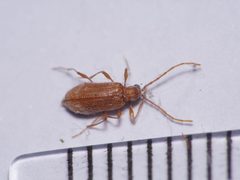
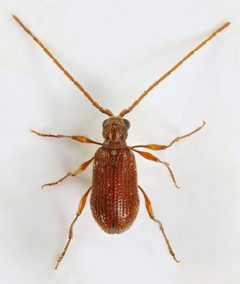
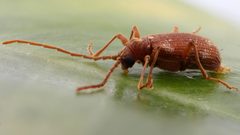
Ptinus fur is a small stored-product pest with a nearly distribution. measure 2.0–4.3 mm and are distinguished by red-brown coloration with yellow hairs, dense pale hairs on the prothorax, and patches of white on the . The is morphologically similar to Ptinus villiger. It develops optimally at 23°C, completing its in approximately 132 days on fishmeal. Larval in cocoons can extend development by 220–280 days. The species is unlikely to reach large sizes due to its long development period, small output (mean 38.6 eggs per female), and tendency for diapause.
Pronunciation
How to pronounce Ptinus fur: /ˈpti.nʊs fʊr/
These audio files are automatically generated. While they are not always 100% accurate, they are a good starting point.
Identification
Red-brown body covered with yellow hairs. Prothorax densely covered with pale hairs; bear patches of white . Length 2.0–4.3 mm. Morphologically similar to Ptinus villiger (hairy spider beetle), from which it may be distinguished by specific hair and scale patterns.
Images
Habitat
Stored food environments; warehouses; museums; unheated outbuildings. Also recorded in nests of birds, notably the sand martin.
Distribution
Nearly ; worldwide distribution associated with stored products. Records from Europe (Serbia), Atlantic islands (Faial, São Miguel, Santa Maria), and Africa.
Diet
Dried and decaying animal and vegetable material. require food and drinking water. In laboratory conditions, fishmeal produces the heaviest beetles while wheatfeed allows quickest development.
Life Cycle
; larva (normally three moults at 23°C, some individuals with extra moult); mature larva in cocoon with facultative lasting ~220 days at 23°C or ~280 days at 20°C; pupa; . Pre- period 30–60 days. Complete development in mean 132.1 days at 23°C on fishmeal. Adults live several months.
Behavior
Larvae produce webbed, materials on stored products. Some individuals undergo as mature larvae within cocoons. may also diapause in cocoons.
Ecological Role
Stored product pest; unlikely to occur in large numbers due to biological constraints.
Human Relevance
Pest of stored foods in warehouses. Documented pest in museums, damaging stored collections.
Similar Taxa
- Ptinus villigerMorphologically similar hairy spider beetle; distinguished by hair and patterns on prothorax and
- Ptinus sexpunctatusCongeneric stored product pest with similar ; P. sexpunctatus has higher optimum temperature (~30°C), shorter development period (~111 days), and lacks
Sources and further reading
- BugGuide
- Wikipedia
- GBIF taxonomy match
- iNaturalist taxon
- NCBI Taxonomy
- Spider Alert! Guess Who's Coming to UC Davis? | Bug Squad
- New regulations protect Australian fur seals | Blog
- Mite-y Waist: Correcting a 60-Year Error in Mite Morphology
- Bug Eric: Spider Sunday: Spider Enemies
- 7 new spiders named after 7 spider characters | Blog
- Terrifying big spiders soon in the DMV? Meet the Jorō Spider, Trichonephila clavata, and its cousin the Golden Silk Spider, Trichonephila clavipes — Bug of the Week
- Studies on Beetles of the Family Ptinidae. VI.—The Biology ofPtinus fur(L.) andP. sexpunctatusPanzer