
Ptinus sexpunctatus
Panzer, 1795
six-spotted spider beetle, six-spot spider beetle
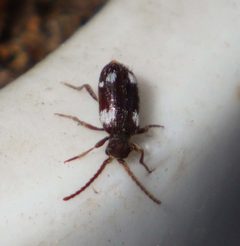
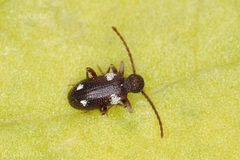
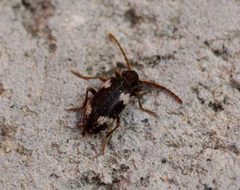
Ptinus sexpunctatus is a small spider beetle (4–5 mm) native to the Palearctic region, now established as an in North America. It is distinguished by its uniform dark coloration with prominent white patches at the base and apex of the , and deeply grooved elytra. The has a commensal relationship with cavity-nesting solitary bees, with larvae developing in nests and feeding on food provisions. It has been recorded as a potential pest in stored products and unheated outbuildings.
Pronunciation
How to pronounce Ptinus sexpunctatus: /ˈptiːnɪs sɛksˌpʌŋkˈtɑːtəs/
These audio files are automatically generated. While they are not always 100% accurate, they are a good starting point.
Identification
Distinguished from other Ptinus by the combination of: uniform dark body coloration; prominent appressed white patches at both basal and regions of (creating six spot-like markings); and deeply grooved elytral . The subgenus Gynopterus placement may aid identification but requires taxonomic expertise. Similar to other spider beetles in general habitus but the distinct white scale pattern is diagnostic.
Images
Habitat
Distribution
Native to the Palearctic region, found throughout Europe. In the United Kingdom, categorized as 'Nationally Notable B' (31–100 hectads). First recorded as in North America in 2007 (Nova Scotia, Canada), with subsequent records from nest contexts. Distribution likely expanding due to commercial bee hotel use.
Diet
Larvae feed on food provisions stored by bees in nests. In laboratory conditions, develops on wheatfeed and fishmeal. require food and drinking water.
Host Associations
- Osmia cornuta - commensal (larvae in nests)possible introduction to North America
- Osmia cornifrons - commensal (larvae in nests)possible introduction to North America
- Osmia lignaria - commensal (larvae in nests)recorded from Nova Scotia, Canada
- Megachile sp. - commensal (larvae in nests)leaf cutter nests in Kent, England
- Lariophagus rufipes - ectoparasitoid of larvae, recorded in Kent, England
Life Cycle
Development at 70% relative humidity: optimum temperature slightly below 30°C, with development completed in approximately 111 days on wheatfeed. hatch at 30°C. Well-defined occurs as mature larvae in cocoons. Some individuals undergo as mature in cocoons (43.5 days on fishmeal, 103.0 days on wheatfeed at 23°C). Adults live several months. Mean egg output per female: 21.3 eggs at 25°C.
Behavior
Commensal nesting : larvae inhabit and feed within solitary nests. Capable of in unheated structures. Some exhibit in cocoons before .
Ecological Role
Commensal associated with cavity-nesting . for ectoparasitoid Lariophagus rufipes. Potential pest of stored products. may be increasing due to rise in artificial bee hotels.
Human Relevance
Potential pest in stored products and unheated outbuildings. in North America, likely introduced via commercial trade (Osmia spp.). Subject of conservation interest in UK (Nationally Notable B status). Increasingly recorded due to popularity of domestic bee hotels.
Similar Taxa
- Ptinus furSimilar size and habitus, but P. sexpunctatus has distinct white patches on and higher optimum development temperature (~30°C vs. ~23°C); P. fur has longer development period, smaller output, and more pronounced larval tendency
More Details
Temperature Tolerance
hatch at 30°C, which is near the maximum temperature for development of the related Ptinus fur. This higher temperature may facilitate establishment in warmer environments.
Taxonomic Note
Placed in subgenus Gynopterus (described by Mulsant and Rey, 1868), one of eleven Ptinid in this subgenus.
Sources and further reading
- BugGuide
- Wikipedia
- GBIF taxonomy match
- iNaturalist taxon
- NCBI Taxonomy
- Studies on Beetles of the Family Ptinidae. VI.—The Biology ofPtinus fur(L.) andP. sexpunctatusPanzer
- Lariophagus rufipes Hedqvist (Hymenoptera: Chalcidoidea: Pteromalidae) reared from Ptinus sexpunctatus Panzer (Coleoptera: Ptinidae) in nesting tubes occupied by Megachile sp. leaf cutter bees (Hymenoptera: Apoidea) in Kent, England