
Ptinus
Linnaeus, 1767
spider beetles
Species Guides
26- Ptinus bicinctus
- Ptinus bimaculatus(Two-spotted spider beetle)
- Ptinus caelebs
- Ptinus californicus(California spider beetle)
- Ptinus concurrens
- Ptinus constrictus
- Ptinus fallax
- Ptinus falli(spider beetle)
- Ptinus feminalis
Ptinus is a globally distributed of spider beetles in the Ptinidae. in this genus are primarily associated with stored food products and dried organic materials. At least 24 species have been documented as pests of stored goods, feeding on grain, dried fruit, spices, and other dry foodstuffs. The genus includes several subgenera and numerous species, with some such as Ptinus tectus recognized as significant pests in museums and storage facilities.
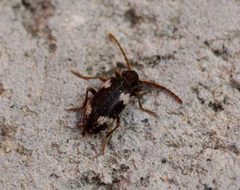
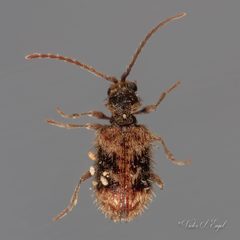
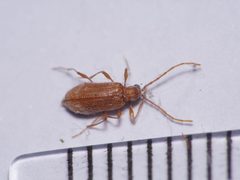
Pronunciation
How to pronounce Ptinus: /ˈptiːnəs/
These audio files are automatically generated. While they are not always 100% accurate, they are a good starting point.
Identification
Members of Ptinus can be distinguished from other Ptininae by their elongated, somewhat cylindrical body form and long, slender legs that give a spider-like appearance. The pronotum is typically constricted at the base, and are usually 11-segmented with a gradual or abrupt club. Accurate identification within the genus requires examination of male genitalia and subtle differences in antennal structure, punctation patterns, and body proportions.
Images
Habitat
in this inhabit stored food products, grain warehouses, mills, museums, and domestic dwellings. Natural have been recorded in bird nests, which may serve as sources of for stored products. The genus shows broad across temperate and tropical regions.
Distribution
Distributed throughout Africa, the Australian region, the Palearctic, the Near East, the Nearctic, and the . GBIF records confirm presence in Denmark, Norway, Sweden, and the United States (Vermont).
Diet
Both and larvae feed on grain, dried fruit, spices, and other dried foodstuffs. Some have been observed to damage stored museum collections and organic artifacts.
Life Cycle
Development is temperature-dependent. In Ptinus tectus, -to- development ranges from approximately 62 days at 23–25°C to 130 days at 15°C. Minimum temperature for complete development is below 10°C; maximum is between 28–30°C with considerable mortality at upper limits. Humidity requirements vary by stage; egg hatching is sensitive to low humidity. Adults may live up to one year under favorable conditions.
Behavior
exhibit negative and positive thigmotaxis. Activity patterns show a rhythm with maximum locomotion during dark periods; this rhythm can be reversed by altered light schedules. Temperature change stimulates activity regardless of direction—both rising and falling temperatures increase movement, with magnitude depending on speed and direction of change. Adults aggregate around 4°C and 24°C in temperature gradients; the lower reflects cold-induced behavioral failure rather than preference. Humidity responses are complex: normal animals collect in drier regions at low humidities, show no response at 75–90% RH, and reverse to wetter preference at 90–100% RH. Desiccated individuals show weakened or reversed humidity reactions. A 'group effect' has been documented in larvae: development is prolonged and size reduced when reared in groups compared to isolated individuals, even with abundant food.
Ecological Role
Decomposer of dried organic matter in natural and anthropogenic environments. As stored product pests, in this contribute to food spoilage and economic loss. In museum contexts, they damage organic collections including dried specimens, textiles, and wooden objects.
Human Relevance
Approximately 24 are documented pests of stored food products worldwide. Ptinus tectus is a significant pest in museums, capable of damaging stored collections and artifacts. The is subject to control measures in food storage and heritage preservation contexts. Research on Ptinus tectus has informed understanding of temperature-dependent efficacy.
Similar Taxa
- GibbiumAlso in Ptininae with spider-like appearance, but Gibbium have more globose bodies and shorter legs relative to body size.
- NiptusAnother spider beetle ; Niptus hololeucus (golden spider beetle) differs in uniform pale coloration and more densely pubescent body surface.
- MeziumShares elongated form but Mezium typically have more parallel-sided and different antennal club structure.
More Details
Subgeneric classification
The is divided into at least six subgenera: Bruchoptinus, Cyphoderes, Gynopterus, Pseudoptinus, Ptinus (nominate), and Tectoptinus. This classification reflects morphological diversity in antennal structure, body form, and male genitalia.
Research significance
Ptinus tectus has been extensively studied as a model organism for understanding temperature-dependent , humidity reception, and group effects in insect development. Findings have direct application to pest management and testing protocols.
Taxonomic note
Ptinus tectus is sometimes treated as Ptinus ocellus in recent literature, reflecting ongoing taxonomic revision. The 1942 studies cited here used the name Ptinus tectus Boie (or Boieldieu).
Sources and further reading
- BugGuide
- Wikipedia
- GBIF taxonomy match
- iNaturalist taxon
- NCBI Taxonomy
- Catalogue of Life
- The Biology and Behaviour of Ptinus Tectus Boie. (Coleoptera, Ptinidae), A Pest of Stored Products
- The Biology and Behaviour of Ptinus Tectus Boie. (Coleoptera, Ptinidae), A Pest of Stored Products
- The Biology and Behaviour of Ptinus Tectus Boie (Coleoptera, Ptinidae), A Pest of Stored Products
- The Biology and Behaviour of Ptinus Tectus Bole. (Coleoptera, Ptinidae), A Pest of Stored Products
- The Biology and Behaviour of Ptinus Tectus Boie. (Coleoptera, Ptinidae), a Pest of Stored Products
- The Biology and Behaviour of Ptinus Tectus Boie. (Coleoptera, Ptinidae), A Pest of Stored Products
- Birds nests as sources of infestations of Ptinus tectus Boieldieu (Coleoptera, Ptinidae) and the distribution of this insect in stacks of bagged flour