
Ptinus tectus
Boieldieu, 1856
Australian spider beetle
Ptinus tectus is a small commonly known as the Australian . It is a stored product pest that originated in Australia and spread to Europe and the UK around 1900. The is notable for its spider-like appearance and its status as a significant pest of stored foods, museum specimens, and historic collections. It has been recorded from at least 55 museums and historic houses in the United Kingdom.
Pronunciation
How to pronounce Ptinus tectus: /ˈptiː.nəs ˈtɛk.təs/
These audio files are automatically generated. While they are not always 100% accurate, they are a good starting point.
Identification
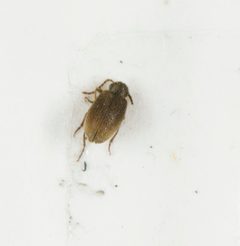
measure 2.5–4 mm in length and are uniformly dark brown in color. The body is stout with a pronounced constriction of the pronotum (neck shield), giving a spider-like appearance. Six long, thin legs with 5-segmented contribute to this superficial resemblance to spiders. Adults possess biting mouthparts, a well-developed , and 11-segmented .
Images
Habitat
Primarily associated with stored products in warehouses, food storage facilities, and museum collections. In empty premises, hide in building fabric, particularly at wall-floor junctions. Also recorded from bird nests and warehouse refuse. Can survive winter outdoors in temperate regions when sheltered.
Distribution
distribution. Native to Australia; introduced to Europe and the United Kingdom around 1900. Present in cool and temperate regions worldwide; very rarely found in hot climates. Records include the UK, Europe, North America, Austria, and Serbia.
Seasonality
Activity greatest during darkness. Two complete per year in temperate conditions, with overlapping generations due to winter survival of all stages.
Diet
Feeds on a wide range of stored foodstuffs including fortified flour, wheatfeed, and other grain products. Optimal laboratory diet is 95% whole ground wheat with 5% dried brewer's yeast.
Life Cycle
Females lay 100–120 sticky over 4–5 weeks in early summer, singly or in small batches. At 20–25°C, eggs hatch in 3–16 days. Larvae are fleshy, curved, covered with fine hairs, and relatively immobile; they moult 4–5 times over at least 6 weeks. Mature larvae spin cocoon for . emerge after 20–30 days and may live up to 12 months. At 23–25°C and 70% relative humidity, development from egg to adult averages about 62 days; at 15°C, approximately 130 days. Minimum temperature for complete development is 10°C; maximum is 28–30°C, with considerable mortality at upper temperatures.
Behavior
Exhibits strong negative (photonegative), with maximum locomotory activity occurring during dark periods. Shows a activity rhythm that can be rapidly reversed by changing light-dark cycles. Activity continues in continuous light for a few days before becoming arrhythmic. Temperature affects activity in complex ways: activity increases with temperature change (whether rising or falling), with magnitude depending on speed and direction of change. Aggregates around 4°C and 24°C in temperature gradients; the lower represents cold-induced immobility rather than true preference. Reacts to humidity gradients by moving toward drier regions at most humidities, but this reaction weakens at 75–90% RH and reverses at 90–100% RH.
Ecological Role
Pest of stored products. Larvae bore through cellophane, card, and textiles, and can make impressions on wood. Economic damage includes holing of packages and of high-grade produce with silk from larval cocoons. cannot penetrate sound linen bags but lay through mesh.
Human Relevance
Significant pest of stored food products and museum collections. Recorded from at least 55 museums and historic houses in the UK. Can reduce food value of produce when are large.
Sources and further reading
- BugGuide
- Wikipedia
- GBIF taxonomy match
- iNaturalist taxon
- NCBI Taxonomy
- The Biology and Behaviour of Ptinus Tectus Boie. (Coleoptera, Ptinidae), A Pest of Stored Products
- The Biology and Behaviour of Ptinus Tectus Boie. (Coleoptera, Ptinidae), A Pest of Stored Products
- The Biology and Behaviour of Ptinus Tectus Bole. (Coleoptera, Ptinidae), A Pest of Stored Products
- The Biology and Behaviour of Ptinus Tectus Boie (Coleoptera, Ptinidae), A Pest of Stored Products
- The Biology and Behaviour of Ptinus Tectus Boie. (Coleoptera, Ptinidae), A Pest of Stored Products
- The Biology and Behaviour of Ptinus Tectus Boie. (Coleoptera, Ptinidae), a Pest of Stored Products
- Studies on Beetles of the Family Ptinidae IX.—A Laboratory Study of the Biology ofPtinus tectusBoield
- Studies on Beetles of the Family Ptinidae
- Birds nests as sources of infestations of Ptinus tectus Boieldieu (Coleoptera, Ptinidae) and the distribution of this insect in stacks of bagged flour
- LIFE HISTORY DATA FOR PTINUS TECTUS BOIE. (COLEOPTERA, PTINIDAE) AT 70% RELATIVE HUMIDITY AT 21° C. AND 25°C.