
Melalgus
Dejean, 1833
horned powder-post beetles
Species Guides
2- Melalgus confertus(branch and twig borer)
- Melalgus plicatus(Groove-sided Bostrichid)
Melalgus is a of beetles in the Bostrichidae, commonly referred to as horned powder-post beetles. The genus was established by Dejean in 1833 and contains more than 20 described . Members of this genus are wood-boring beetles that contribute to the degradation of dead wood in forest . The "horned" refers to a distinctive cephalic projection present in many species.
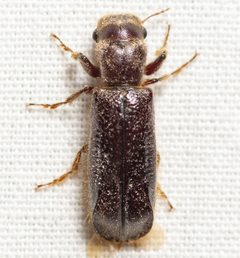
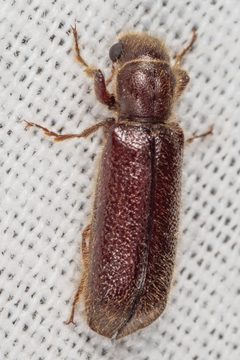
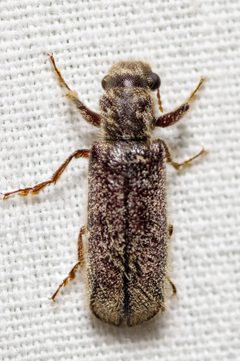
Pronunciation
How to pronounce Melalgus: //meˈlælɡəs//
These audio files are automatically generated. While they are not always 100% accurate, they are a good starting point.
Identification
in Melalgus can be distinguished from other Bostrichidae by the presence of a prominent horn-like projection on the , particularly pronounced in males. The body is cylindrical and adapted for boring into wood. They are generally larger than related powder-post beetles in the Lyctus. are clubbed with three distinct segments in the club. The pronotum often has marginal teeth or , varying among species.
Images
Habitat
in this are associated with dead and decaying hardwoods. They are found in forested environments where standing dead trees, fallen logs, and cut timber provide suitable substrate for larval development. Some species have been documented in seasoned lumber and wooden structures, though they are generally less destructive to processed wood than Lyctus species.
Distribution
The has a broad distribution, with recorded from North America, Central America, South America, Europe, Asia, and Africa. Specific distribution patterns vary by species, with some showing restricted regional ranges and others exhibiting wider geographic spread.
Diet
Larvae feed on wood, tunneling through the xylem of dead hardwoods. The diet is restricted to wood with sufficient starch content; larvae cannot digest cellulose directly and rely on starches and sugars present in the wood. do not feed on wood and have been observed taking nectar or not feeding at all.
Life Cycle
Development follows complete with , larva, pupa, and stages. Females bore into wood to create galleries where eggs are deposited. Larvae tunnel extensively through wood, creating packed -filled galleries. occurs in enlarged chambers near the wood surface. The duration varies with wood moisture, temperature, and nutritional quality, ranging from several months to multiple years.
Behavior
are and attracted to light. Males use the cephalic horn in combat with other males for access to females. Both sexes bore into wood, though females create the primary oviposition galleries. Adults are capable of and disperse to locate new material.
Ecological Role
As primary decomposers of dead hardwoods, these beetles accelerate wood decay and nutrient cycling in forest . Their tunneling activity increases wood porosity and water retention, facilitating by fungi and other decomposers. They contribute to the creation of for other saproxylic organisms.
Human Relevance
Some occasionally infest seasoned hardwood lumber, flooring, and furniture, causing structural degradation through larval tunneling. They are generally considered secondary pests, preferring wood that is already partially degraded. are less common and typically less severe than those caused by Lyctus powder-post beetles. Control relies on proper wood seasoning and storage practices.
Similar Taxa
- LyctusAlso called powder-post beetles and in the same , but Lyctus are smaller, lack the prominent cephalic horn, and are more frequently pests of processed hardwood products.
- PolycaonShares the Polycaoninae and has similar body form, but Polycaon lack the distinctive horn and have different antennal club structure.
- DinoderusAnother bostrichid with wood-boring larvae, but Dinoderus are smaller, have different pronotal armature, and are primarily associated with bamboo and tropical hardwoods.
More Details
Taxonomic History
The was originally described by Pierre François Marie Auguste Dejean in 1833. It has been variously classified within Bostrichidae, with modern molecular and morphological studies supporting placement in the Polycaoninae. The number of recognized has expanded through recent taxonomic revisions, with 25 currently accepted species.
Sexual Dimorphism
Males typically bear larger and more elaborate cephalic horns than females, with horn serving as a key character for identification. In some species, females possess reduced horns or , while in others the horn is nearly absent in females.