
Elaphropus quadrisignatus
(Duftschmid, 1812)
A small ground beetle in the Carabidae, originally described as *Elaphrus quadrisignatus* by Duftschmid in 1812 and later transferred to *Elaphropus*. The is documented from scattered records across Europe and North Africa, with 24 observations reported on iNaturalist. As a member of the tribe Bembidiini, it belongs to a diverse group of small carabids often associated with moist microhabitats.
Pronunciation
How to pronounce Elaphropus quadrisignatus: //ɛˈlæf.rə.pəs kwɑːˌdraɪ.sɪɡˈneɪ.təs//
These audio files are automatically generated. While they are not always 100% accurate, they are a good starting point.
Identification
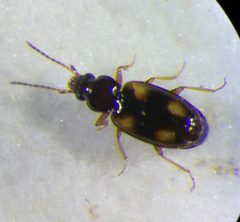
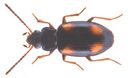
The specific epithet "quadrisignatus" (four-marked) suggests the presence of four distinct markings on the , though this requires verification from original descriptions or . Members of *Elaphropus* are generally small (2–5 mm), with compact bodies, short elytra, and reduced or absent hind wings. Accurate identification to level requires examination of male genitalia and comparison with type material.
Images
Distribution
Recorded from Austria, Belgium, Bulgaria, Algeria, and the former Yugoslavia. The disjunct distribution pattern suggests either genuine wide range or potential taxonomic confusion with similar .
Similar Taxa
- Elaphropus parvulusSimilar small size and general habitus; distinguished by differences in elytral and
- Other Tachyura subgenus speciesShare compact body form and reduced wings; require dissection for reliable separation
More Details
Nomenclatural history
The was originally described in the *Elaphrus* by Duftschmid in 1812, a genus now restricted to much larger, distinctive carabids. The transfer to *Elaphropus* reflects improved understanding of tribal relationships within Bembidiini. The *E. q. quadrisignatus* is recognized in some sources, though its validity requires verification.
Data limitations
This has received limited modern study. Most records predate comprehensive taxonomic revisions of the *Elaphropus*, and the true distribution and remain poorly documented. The 24 iNaturalist observations suggest it is infrequently encountered or underreported.