
Bembidion quadrimaculatum
(Linnaeus, 1760)
Garden Bembidion Beetle
Species Guides
2Bembidion quadrimaculatum is a small ground beetle in the Carabidae with a broad distribution spanning Europe, Northern Asia, North America, and Southern Asia. The is recognized as an important component of agricultural , where it serves as a beneficial . Multiple have been described, including the nominate B. q. quadrimaculatum and the North American B. q. oppositum. have been observed to respond positively to conservation tillage practices in agricultural settings.
Pronunciation
How to pronounce Bembidion quadrimaculatum: /bɛmˈbɪd.i.ɒn ˌkwɑː.drɪˌmæk.jəˈleɪ.təm/
These audio files are automatically generated. While they are not always 100% accurate, they are a good starting point.
Identification
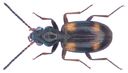
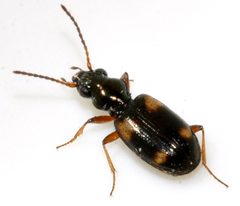
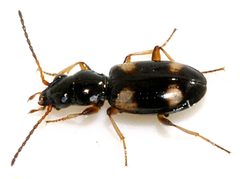
Small ground beetle, typically 3–5 mm in length. The specific epithet 'quadrimaculatum' (four-spotted) suggests four distinct maculations or markings, though detailed pattern description is not provided in available sources. As with other Bembidion , it likely exhibits the -characteristic elongated body form and relatively long legs adapted for rapid movement.
Images
Habitat
Agricultural fields and associated disturbed . A 2013–2014 study in Pennsylvania and Maryland found the in squash and melon production systems, where it was particularly associated with strip-tillage plots. The B. q. oppositum has been documented in similar agricultural contexts.
Distribution
Europe and Northern Asia (excluding China), North America, and Southern Asia. Specific distribution records include: former Yugoslavia, Afghanistan, Alaska, Armenia, and Austria. The occurs across temperate regions of the Northern Hemisphere with multiple recognized reflecting this broad range.
Diet
Predatory; as a carabid , feeds on other small . In agricultural systems, it has been documented as part of the beneficial ground beetle that contributes to pest suppression.
Behavior
Active ground-dwelling . In agricultural studies, individuals were captured in pitfall traps, indicating surface-foraging typical of carabid beetles.
Ecological Role
Beneficial in agricultural . Contributes to of pest in crop fields. The has been identified as a bioindicator of farming practice impacts, showing sensitivity to tillage intensity. Strip-tillage methods, which reduce soil disturbance, have been observed to support higher of this species compared to conventional tillage or plasticulture systems.
Human Relevance
Recognized as a beneficial insect in agricultural pest management. Its presence in crop fields indicates reduced tillage intensity and supports approaches. The has been specifically studied in the context of sustainable agriculture practices in cucurbit production.
Similar Taxa
- Bembidion rapidumCo-occurs in agricultural and was captured alongside B. quadrimaculatum in Pennsylvania/Maryland strip-tillage studies; similar size and ecological role
- Bembidion brownorumSimilar and general form, but distinguished by larger size (5 mm vs. 3–4 mm), more robust prothorax, and restricted California distribution
- Harpalus pensylvanicusSympatric carabid in agricultural systems; both are common in strip-tillage plots but distinguished by -level morphological differences