
Bembidion lampros
(Herbst, 1784)
A small ground beetle native to Europe, now established in North America. overwinter and reproduce in early spring in arable fields, where they function as of cereal aphids. The exhibits wing dimorphism with three phenotypes, though individuals rarely possess functional muscles. Low lifetime (approximately 10 per female) and high mortality (66%) make sensitive to conditions during larval development.
Pronunciation
How to pronounce Bembidion lampros: /bɛmˈbɪdi.ɔn ˈlæmprɒs/
These audio files are automatically generated. While they are not always 100% accurate, they are a good starting point.
Identification
Distinguished from similar carabids by the straight midline where meet. Wing dimorphism is notable but requires examination of wing development. Antennal structure (13+ types including sensilla chaetica, trichodea, basiconica, coeloconica, and campaniformia) is diagnostically detailed but requires microscopy. Differs from Trechus secalis in reproductive timing: B. lampros breeds in early summer (June) versus mid-summer (July) for T. secalis. Less active than Pterostichus cupreus at comparable temperatures; inactive below 9–10°C.
Images
Appearance
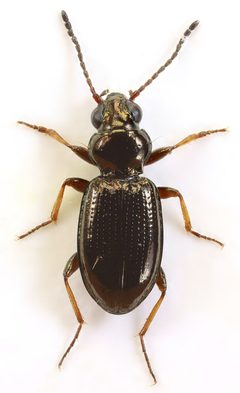
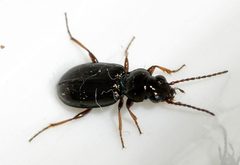
Small ground beetle with forewings modified as hardened meeting in a straight line down the middle of the . , 1.6–1.8 mm long, composed of scape, , and nine flagellomeres. Exhibits wing dimorphism: two short-winged (brachypterous) phenotypes and one long-winged () phenotype. Only 5.9% of macropterous individuals possess muscles.
Habitat
Arable farmland, particularly cereal fields. Overwinters at field edges in grassy boundaries, then moves to field centers in early spring to reproduce. Prefers bare ground and low crop ; abundance positively correlated with grassy strips surrounding crop fields. Does not reproduce in adjacent uncultivated .
Distribution
Native to Europe; recorded from Albania, Armenia, and former Yugoslavia. Introduced and established in North America: Canada and USA. Specific distribution within North America not detailed in sources.
Seasonality
overwinter and become active in spring. occurs in early summer (June). New emerges in late summer (August). , with one generation per year. Inactive at temperatures below 9–10°C; activity and consumption rates increase with temperature up to 25°C.
Diet
. Consumes cereal aphids, particularly Rhopalosiphum padi. Maximum consumption at 25°C: approximately 16 first to third instar nymphs or 9 aphids per day. Captures prey on soil surface; does not climb plants to search for aphids.
Life Cycle
. emerge in autumn, hibernate during winter, disperse into arable fields in spring to reproduce, then die. -laying begins approximately 100 (above 9°C) after from sites. Larvae partly surface-active (unlike completely subterranean Trechus secalis). Survival from first instar to adult averages 34%, independent of soil type.
Behavior
Thermally constrained: inactive below 9–10°C, unable to be captured in pitfall traps at lower temperatures. Prefers bare ground between plants, possibly to maintain body temperature via solar exposure. Does not increase searching time in response to increased prey . Uses hedgerows as preferred routes. Survives extended starvation: can live several weeks without food after hibernation, with females surviving on average ten days longer than males under starvation conditions.
Ecological Role
of cereal aphids in agricultural . Early spring activity allows it to contribute to pest control before later-moving predator become active. sensitive to survival conditions; potential for enhancement to improve natural if larval development conditions are optimized.
Human Relevance
Beneficial for agricultural pest management through . Potential for via management of field boundaries and hedgerows to support and . No negative impacts reported.
Similar Taxa
- Trechus secalisOverlaps in and geographic range; differs in larval versus overwintering in B. lampros, and mid-summer (July) versus early summer (June) breeding.
- Pterostichus cupreusCo-occurring carabid of cereal aphids; more active at all temperatures, consumes more prey (125 aphids/day at 20°C versus 9 for B. lampros), and climbs plants to search for aphids— not observed in B. lampros.
- Tachyporus hypnorumSimilar size, , and ; differs in higher (approximately 30 versus 10 for B. lampros) and shorter starvation survival.
More Details
Antennal Sensilla
contain more than 13 types of including three types of sensilla chaetica, two types of sensilla trichodea, five types of sensilla basiconica, sensilla coeloconica, sensilla campaniformia, and Böhm sensilla. Three types identified as olfactory (sensilla trichodea type 2, sensilla basiconica types 1 and 2). No in sensilla types, numbers, or distribution.
Overwintering Biology
Survival higher in harsh winters with constant subzero temperatures than in temperate winters, because mild conditions may delay entry until after lethal cold exposure. Higher densities increase overwinter survival, likely through dilution effects, without improving individual body condition. Field interior sites show higher survival than grassy boundaries, contrary to typical preference.
Energy Reserves
Fat content maintained at approximately 23% when fed ad libitum or collected in spring field conditions. Death from starvation occurs at approximately 7% fat content. Minimal weight loss during indicates food shortage is not a major mortality factor in early spring.
Sources and further reading
- BugGuide
- Wikipedia
- GBIF taxonomy match
- iNaturalist taxon
- NCBI Taxonomy
- Rare beetle, rediscovered after 55 years, named in honor of Jerry Brown
- Pollen Bath | Beetles In The Bush
- Ecology of Two Carabid Beetles, Bembidion lampros (Herbst) and Trechus quadristriatus (Schrank)
- Ecology of Two Carabid Beetles, Bembidion lampros (Herbst) and Trechus quadristriatus (Schrank)
- Antennal sensilla of the ground beetle Bembidion lampros Hbst (Coleoptera, Carabidae)
- Fecundity and juvenile survival of Bembidion lampros and Tachyporus hypnorum
- The effects of habitat, density, gender and duration on overwintering success in Bembidion lampros (Coleoptera: Carabidae)
- Capacity of Bembidion lampros and Tachyporus hypnorum to survive periods of starvation in early spring
- Habitat selection, reproduction and survival of two small carabid species on arable land: a comparison between Trechus secalis and Bembidion lampros
- Searching behaviour and cereal aphid consumption by Bembidion lampros and Pterostichus cupreus, in relation to temperature and prey density