
Pachyteles
Perty, 1830
Species Guides
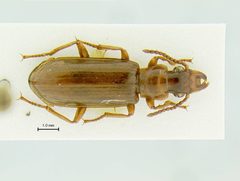
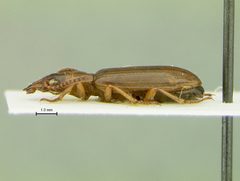
1Pachyteles is a of ground beetles in the Carabidae, Paussinae, tribe Ozaenini. It contains more than 50 described . The genus was established by Perty in 1830. Members of this genus are part of the flanged bombardier beetle group within the ozaenine lineage.
Pronunciation
How to pronounce Pachyteles: //ˈpæ.kɪˌtɛ.lɛs//
These audio files are automatically generated. While they are not always 100% accurate, they are a good starting point.
Identification
Pachyteles can be distinguished from other Ozaenini by their robust, somewhat flattened body form and the presence of prominent lateral flanges on the pronotum and . These flanges are a characteristic feature of the subtribe Ozaenina. The is morphologically intermediate between the more derived Paussini and other ozaenine genera. Species-level identification requires examination of male genitalia and subtle differences in flange development and body proportions.
Images
Habitat
in this are associated with forested , particularly tropical and subtropical regions. They are ground-dwelling beetles found in leaf litter and soil environments. Specific microhabitat preferences vary by species but generally include moist, shaded conditions in woodland .
Distribution
The has a Neotropical distribution, with recorded from Central and South America. Records extend from Mexico through Central America to South America, including Brazil and adjacent countries.
Behavior
Like other Ozaenini, Pachyteles are ground beetles. They have been observed to exhibit defensive chemical secretion typical of the bombardier beetle lineage, though specific details for this are not well documented.
Ecological Role
As predatory ground beetles, in this likely function as of small in forest floor . Their specific ecological impacts have not been quantified.
Human Relevance
No direct human relevance has been documented. The is of interest to coleopterists studying the evolution of chemical defense and the of Paussinae.
Similar Taxa
- OzaenaAlso in tribe Ozaenini with pronotal and elytral flanges, but Ozaena generally have more reduced and different antennal proportions.
- GoniotropisAnother ozaenine with flanged pronotum, but differs in body shape and flange development pattern.
- PaussusIn the same Paussinae but tribe Paussini; Paussus are myrmecophilous with highly modified and body form, unlike the free-living Pachyteles.
More Details
Taxonomic history
The has undergone taxonomic revision, with Deuve (2001) providing an updated authority citation. The subtribal placement in Ozaenina reflects current understanding of relationships within Paussinae.
Research status
Despite containing over 50 , Pachyteles remains poorly studied biologically. Most species are known from few specimens, and natural history data are largely lacking.