
Leistus ferrugineus
Linnaeus, 1758
Palearctic rusty basket-throat
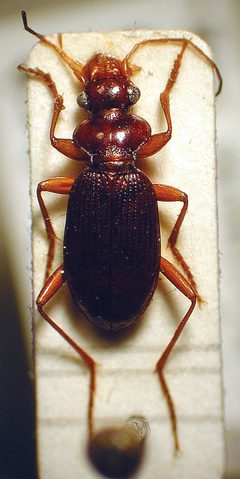
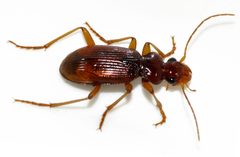
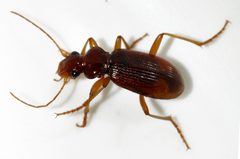
Leistus ferrugineus is a of ground beetle in the Carabidae, native to the Palearctic region and introduced to northeastern North America. It inhabits mixed forests, where it occurs on moist gravelly ground, grassy areas, hedges, and open woodland. are brachypterous, possessing reduced wings that limit capability. The species is part of the Nebriinae, a group of ground beetles often associated with cool, moist .
Pronunciation
How to pronounce Leistus ferrugineus: /ˈlaɪstʊs ˌfɛrʊˈdʒɪniəs/
These audio files are automatically generated. While they are not always 100% accurate, they are a good starting point.
Identification
can be distinguished from other Leistus by the ferrugineous (rust-colored) body coloration implied by the specific epithet. The brachypterous condition of adults is a notable trait, though this is shared with other members of the . Accurate identification to species level typically requires examination of genitalic structures and comparison with described specimens.
Images
Habitat
Mixed forests, specifically on moist gravelly ground and grassy areas, as well as in hedges and open woodland. The shows preference for moist microhabitats within forested landscapes.
Distribution
Native to the Palearctic region, including Europe (Austria, Baltic states, Benelux, Great Britain including Isle of Man, Bulgaria, Czech Republic, Hungary, France, Germany, Ireland, Italy, Kaliningrad, Liechtenstein, Moldova, Northern Ireland, Poland, Romania, Scandinavia, Slovakia, Slovenia, Spain, Switzerland, former Yugoslavia except Republic of Macedonia, and eastern Europe) and parts of Asia. Introduced to northeastern North America, with records from Canada and the United States.
Life Cycle
are brachypterous, indicating reduced capability by . Detailed information including larval development and is not well documented in available sources.
Behavior
are ground-dwelling and active in forest floor . The brachypterous condition suggests limited ability, likely resulting in localized structure.
Ecological Role
As a ground beetle, it likely functions as a in forest floor , though specific prey relationships are not documented.
Similar Taxa
- Other Leistus speciesSimilar body form and preferences; distinguished by coloration, punctation patterns, and genitalic requiring expert examination.
Sources and further reading
- BugGuide
- Wikipedia
- GBIF taxonomy match
- iNaturalist taxon
- NCBI Taxonomy
- Catalogue of Life
- UBI Professor Demonstrates 'How to Draw a Bug' at Bohart Museum Open House | Bug Squad
- Encyrtid Holdings | Entomology Research Museum
- Listening to Larvae: How Acoustics Can Measure Efficacy of Palm Weevil Management
- Northern Ireland, invertebrate finds in review 2023 - Buglife Blog - Buglife
- Long-Distance Palm Weevil Flyers Threaten California Date Palms
- I Brake for Dung Beetles! | Beetles In The Bush