
Loricerinae
Bonelli, 1810
Tribe Guides
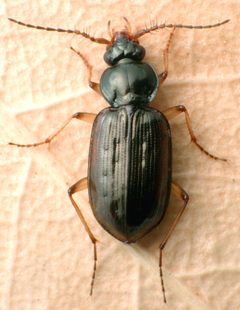
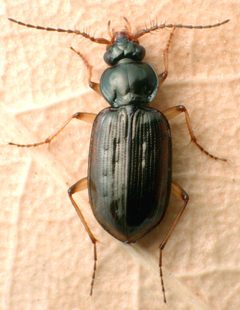
1Loricerinae is a of ground beetles in Carabidae, established by Bonelli in 1810. It is monogeneric, containing only the Loricera. These beetles are recognized for their distinctive flattened, shield-like body form and association with moist . The subfamily is relatively small in but has a broad geographic distribution.
Pronunciation
How to pronounce Loricerinae: //ˌlɔːrɪˈsɛrɪniː//
These audio files are automatically generated. While they are not always 100% accurate, they are a good starting point.
Identification
Distinguished from other Carabidae by the combination of: strongly flattened and shield-shaped body; broad, expanded pronotum that covers the laterally; short, stout legs; and smooth to moderately with distinct basal impressions. Resembles some Scydmaenidae or small staphylinids in general form but differs in having complete elytra covering the and the characteristic carabid mandibular structure. The monogeneric status means any matching this description and assigned to Carabidae belongs to Loricerinae.
Images
Habitat
Primarily associated with moist, shaded microhabitats. Found in leaf litter, moss, and decaying organic matter in forested areas. Often in riparian zones, wetlands, and swampy woodlands. Requires high humidity and is typically found in cool, damp situations under stones, logs, or in saturated soil layers.
Distribution
Widespread across the Holarctic region. Present in North America, Europe, and Asia. Individual have more restricted ranges, but the Loricera collectively spans northern temperate and zones.
Seasonality
are generally active in spring and early summer, with some showing autumn activity. Activity patterns tied to moisture availability; may be found year-round in suitable microhabitats but surface activity decreases during dry or cold periods. Larval development occurs primarily in summer months.
Life Cycle
Complete with , larva, pupa, and stages. Larvae are campodeiform (elongate and active), typical of Carabidae. Development occurs in moist soil or litter. Specific details on egg laying, larval instars, and sites are poorly documented for most .
Behavior
Ground-dwelling and cryptic, spending much time concealed in moist substrate. When exposed, moves quickly to seek cover. or activity patterns suspected but not well studied. Not known to fly readily; wing reduction reported in some .
Ecological Role
Predatory members of forest floor and wetland litter . Contribute to regulation of small in moist microhabitats. Part of the decomposer , linking detrital to higher .
Human Relevance
No significant direct economic importance. Occasionally collected by entomologists and used as indicators of intact, moist forest . Not known as agricultural pests or beneficial biocontrol agents.
Similar Taxa
- ElaphrinaeSome Elaphrinae share moist preferences and flattened body forms, but have more elongated bodies, longer legs relative to body size, and different pronotal proportions.
- ScydmaenidaeSimilar small, flattened body form and , but Scydmaenidae have clubbed , much smaller size, and different mandibular structure.
- Staphylinidae (some genera)Superficially similar flattened, shield-like appearance in some rove beetles, but have abbreviated exposing most of the and different antennal and leg proportions.
More Details
Taxonomic stability
Loricerinae has remained taxonomically stable as a monogeneric , with Loricera as its sole . This contrasts with many other carabid subfamilies that have undergone repeated revision.
Phylogenetic position
Molecular and morphological studies place Loricerinae in a basal position within Carabidae, though exact relationships with other early-diverging lineages remain under study.