
Pterostichus stygicus
Say, 1823
Woodland ground beetle
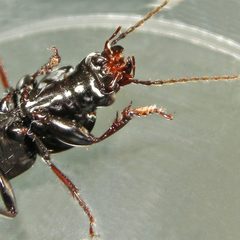
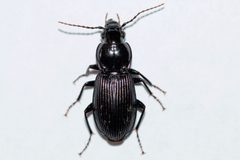
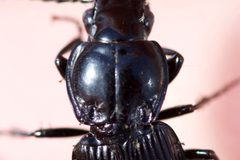
Pterostichus stygicus is a of ground beetle in the Carabidae, native to North America. It inhabits deciduous forest floor environments where it functions as a . The species has been studied for its competitive interactions and intraguild relationships with centipedes, particularly Scolopocryptops sexspinosus.
Pronunciation
How to pronounce Pterostichus stygicus: /tɛɹoʊˈstɪkəs ˈstɪdʒɪkəs/
These audio files are automatically generated. While they are not always 100% accurate, they are a good starting point.
Images
Habitat
Deciduous forest floor; specifically beneath rocks and logs on the forest floor, especially during dry periods when prey become confined to such microhabitats.
Distribution
North America; recorded from Canada and the United States.
Diet
; consumes leaf litter mesofauna. Prey items overlap with those of co-occurring centipedes (Scolopocryptops sexspinosus).
Behavior
Engages in competition and intraguild with centipedes (Scolopocryptops sexspinosus). In laboratory mesocosms, exhibits negative co-occurrence with centipedes beneath cover objects. Loses mass under solitary, intra- and interspecific conditions. Shows less favorable response to competition compared to centipedes.
Ecological Role
in forest floor . Participates in intraguild dynamics that may weaken top-down control on lower .
More Details
Intraguild predation dynamics
Laboratory studies demonstrate asymmetric intraguild between P. stygicus and Scolopocryptops sexspinosus, with high mortality of beetles when paired with centipedes. Centipedes maintained weight across treatments while beetles lost mass in all conditions, suggesting differential competitive ability.
Sources and further reading
- BugGuide
- Wikipedia
- GBIF taxonomy match
- iNaturalist taxon
- NCBI Taxonomy
- Largest Carabid Beetle in California | Bug Squad
- New Guide Offers Latest in Carrot Weevil Management
- Where siblings mingle: Ellipsoptera marginata vs. E. hamata | Beetles In The Bush
- Reuse of science for the benefit of all: the beauty of open access | Blog
- Pensoft blog - Part 136
- Meet Enus | Beetles In The Bush
- Competition and Intraguild Predation Between Beetles, Pterostichus stygicus (Coleoptera: Carabidae) and Centipedes, Scolopocryptops sexspinosus (Scolopemdromorpha: Scolopocryptopidae)