
Scolopocryptops sexspinosus
(Say, 1821)
Eastern Red Centipede
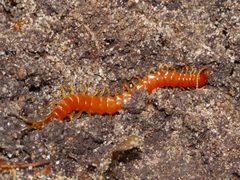
Scolopocryptops sexspinosus, the eastern red , is a large, venomous scolopendromorph centipede native to eastern North America. reach approximately 69 mm in length and are typically orange to reddish-orange in coloration, though southeastern may appear browner. The is active year-round and is notable for its rapid movement and ability to inflict painful bites. It is the only scolopendromorph centipede definitively documented in Canada.


Pronunciation
How to pronounce Scolopocryptops sexspinosus: //skəˌloʊ.poʊˈkrɪptɒps sɛksˈspaɪ.nə.səs//
These audio files are automatically generated. While they are not always 100% accurate, they are a good starting point.
Identification
Distinguished from other North American by the combination of large size (up to 69 mm), orange to reddish-orange coloration, 23 leg-bearing segments, and absence of ocelli (blind). The ultimate legs bear two basal spines: one large, conspicuous, nearly triangular spine on the side and a smaller spine on the inner side near the middle of the basal segment. Tergites display incomplete longitudinal grooves confined to the portion. have very short, dense hair with reduced hairiness on the first antennomere. The second trunk segment behind the is the shortest, followed by the fourth and then the sixth segments.
Images
Habitat
Occurs in diverse terrestrial across eastern North America, from sea level to 1,950 m elevation. Frequently found beneath decaying logs, leaf litter, and bark, where it seeks from desiccation and . In summer, females occupy rotting wood or under bark for protection.
Distribution
Widespread across eastern North America from Florida and the Gulf Coast north to Ontario, Canada, extending west to eastern Texas and Nebraska. In Canada, confirmed only from the Niagara Gorge; records from British Columbia and Vancouver Island previously attributed to this have been reidentified as S. spinicaudus.
Seasonality
active throughout the year.
Diet
Feeds on spiders, insects, earthworms, and smaller .
Behavior
Moves swiftly. Females exhibit parental care by coiling around and recently hatched young to protect them from . Capable of to maintain performance across a broad temperature range. Engages in intraguild and competition with ground beetles (e.g., Pterostichus stygicus), typically dominating in direct interactions due to higher activity levels and speed.
Ecological Role
in forest floor . Functions as an intraguild predator that can suppress of competing carabid beetles through asymmetric . May influence microhabitat use by small vertebrates; salamanders (Plethodon cinereus) exhibit avoidance and are excluded from cover objects in its presence.
Human Relevance
Can inflict a painful bite when handled or disturbed; venomous but not considered medically significant to humans. Often encountered by naturalists and forest when turning logs or leaf litter.
Similar Taxa
- Scolopocryptops spinicaudusPreviously confused with S. sexspinosus in western North America; distinguished by geographic range and subtle morphological differences in ultimate leg spination and tergite .
- Lithobius forficatusIntroduced European stone centipede co-occurring in some eastern forests; smaller (typically under 30 mm), with 15 leg-bearing segments and ocelli present, versus 23 segments and blindness in S. sexspinosus.
Sources and further reading
- BugGuide
- Wikipedia
- GBIF taxonomy match
- iNaturalist taxon
- NCBI Taxonomy
- Catalogue of Life
- Responses of juvenile terrestrial salamanders to introduced (Lithobius forficatus) and native centipedes (Scolopocryptops sexspinosus)
- Competition and Intraguild Predation Between Beetles, Pterostichus stygicus (Coleoptera: Carabidae) and Centipedes, Scolopocryptops sexspinosus (Scolopemdromorpha: Scolopocryptopidae)