
Scolopocryptops
Newport, 1844
Red Centipedes
Species Guides
6- Scolopocryptops gracilis(Western Fire Centipede)
- Scolopocryptops nigridius(Blue Belly Centipede)
- Scolopocryptops peregrinator
- Scolopocryptops rubiginosus
- Scolopocryptops sexspinosus(Eastern Red Centipede)
- Scolopocryptops spinicaudus(Thorn-tailed Bark Centipede)
Scolopocryptops is a of bark centipedes in the Scolopocryptopidae, containing at least 20 described . Members are terrestrial found in forest floor , where they engage in competitive and predatory interactions with other predators including carabid beetles and salamanders. The genus has been studied for its flexible locomotory capabilities, with species such as S. rubiginosus demonstrating dynamic gait switching and phase reversal of locomotory waves. S. sexspinosus has been documented as a native North American species involved in intraguild and competition for microhabitat resources.
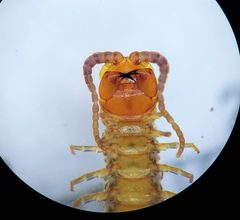
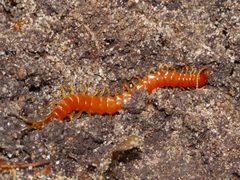
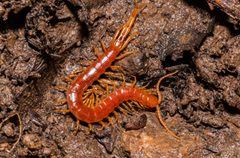
Pronunciation
How to pronounce Scolopocryptops: //ˌskɒləpoʊˈkrɪptɒps//
These audio files are automatically generated. While they are not always 100% accurate, they are a good starting point.
Identification
As a -level entry, specific identification features are not applicable. Individual within Scolopocryptops would require examination of morphological characters such as leg counts, tergite structure, and coloration patterns for differentiation from related genera in Scolopocryptopidae.
Images
Habitat
Terrestrial forest floor environments, particularly beneath rocks and logs where moisture and prey availability are concentrated. occupy deciduous forest litter microhabitats, especially during dry periods when prey become confined to such .
Distribution
Native to North America (S. sexspinosus explicitly documented); broader distribution of requires -level verification.
Diet
on leaf litter mesofauna; specific prey items consumed in laboratory mesocosms included similar resources to competing carabid beetles. Exact prey spectrum not detailed in available sources.
Behavior
Exhibits flexible locomotion with dynamic gait allowing locomotory waves to vary in direction depending on speed and terrain conditions. S. rubiginosus demonstrates phase reversal of locomotory waves and a swimming gait distinct from eel-like undulation, using posteriorly traveling waves of horizontal body undulation. S. sexspinosus engages in intraguild with asymmetric outcomes favoring the over carabid beetles, and excludes salamanders from cover objects through behavioral dominance.
Ecological Role
in forest floor ; engages in intraguild and competition with other predators including carabid beetles (Pterostichus stygicus). Influences microhabitat use patterns of salamanders through behavioral interference. May alleviate predation pressure on lower through competitive interactions with other generalist predators.
Similar Taxa
- LithobiusEuropean introduced compared with Scolopocryptops sexspinosus in behavioral studies; distinguished by native versus introduced status and differential responses from native fauna.
- Pterostichus stygicusCarabid with which S. sexspinosus competes for microhabitat and prey resources; distinguished by trophic and asymmetric intraguild outcomes favoring the .
More Details
Locomotory Innovation
S. rubiginosus challenges the assumption that locomotory wave direction is fixed within a , demonstrating bio-inspired potential for flexible gait control in robotics.
Taxonomic Note
NCBI places this in Cryptopidae rather than Scolopocryptopidae, reflecting ongoing classification discussions; primary sources use Scolopocryptopidae.
Sources and further reading
- BugGuide
- Wikipedia
- GBIF taxonomy match
- iNaturalist taxon
- NCBI Taxonomy
- Catalogue of Life
- Gait switching with phase reversal of locomotory waves in the centipede Scolopocryptops rubiginosus
- Dynamic gait transition in the Scolopendromorpha scolopocryptops rubiginosus L. Koch centipede
- Responses of juvenile terrestrial salamanders to introduced (Lithobius forficatus) and native centipedes (Scolopocryptops sexspinosus)
- Competition and Intraguild Predation Between Beetles, Pterostichus stygicus (Coleoptera: Carabidae) and Centipedes, Scolopocryptops sexspinosus (Scolopemdromorpha: Scolopocryptopidae)