
Panagaeus
Latreille, 1802
Holy Ground Beetles
Species Guides
3- Panagaeus crucigerus
- Panagaeus fasciatus
- Panagaeus sallei(hairy ground beetle)
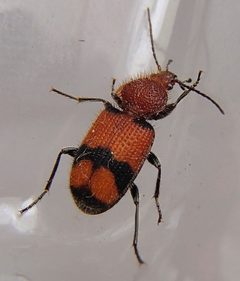
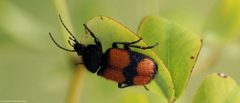
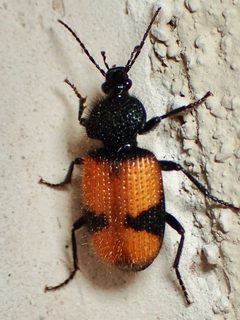
Panagaeus is a of ground beetles (Carabidae) comprising approximately 15 described . The genus has a broad geographic distribution spanning the Holarctic, Near East, North Africa, Central America, and South America. Species within this genus are commonly referred to as "Holy Ground Beetles" due to distinctive markings on the that resemble crosses or other symbolic patterns. The genus was established by Latreille in 1802 and belongs to the Panagaeinae.
Pronunciation
How to pronounce Panagaeus: //pænəˈdʒiəs//
These audio files are automatically generated. While they are not always 100% accurate, they are a good starting point.
Identification
Look for the combination of: (1) ground beetle with prominent and thread-like ; (2) distinctive elytral patterns with contrasting light markings on dark background, often forming crosses, bands, or paired spots; (3) moderate body size typical of carabids. Panagaeus cruxmajor and P. cruciger are particularly recognizable by their cross-shaped markings. Similar in Panagaeinae lack the characteristic cruciform pattern and may have more uniform coloration or different spot arrangements.
Images
Habitat
Terrestrial including forests, woodlands, and open ground. Specific microhabitat preferences vary by , with some associated with moist woodland floors and others in more open, drier situations. The shows ecological flexibility across its broad range.
Distribution
Holarctic distribution including Europe, Asia, and North America; extends to the Near East, North Africa, Central America (Mexico, Panama), and South America (Ecuador). Notable regional concentrations include East Asia (Japan, Korea, China, Russia), North America (United States, Canada, Mexico), and the Palearctic region.
Seasonality
activity patterns vary by and latitude. In temperate regions, active primarily during spring through autumn; some species may be active year-round in milder climates. Specific data limited for most species.
Behavior
Ecological Role
As members of Carabidae, in this function as in soil and ground-level . They contribute to regulation of and serve as prey for larger predators. Specific ecological studies are lacking for most species.
Human Relevance
Limited direct economic importance. The "Holy Ground Beetles" reflects cultural recognition of the cross-like markings. Some (e.g., P. bipustulatus, P. cruxmajor) are familiar to European entomologists and naturalists. No significant documented impacts on agriculture or forestry.
Similar Taxa
- Other Panagaeinae generaSimilar body form and use, but distinguished by elytral pattern—Panagaeus typically shows more contrasting and geometrically regular markings (crosses, bands) rather than uniform coloration or irregular spotting.
- Lebia and related colorful CarabidaeSome Lebia have bright elytral patterns, but these are generally smaller, more delicate in build, and lack the robust ground beetle of Panagaeus.
More Details
Etymology
The "Holy Ground Beetles" directly references the cross-shaped (cruciform) markings found on several , particularly P. cruxmajor ("greater cross") and P. cruciger ("cross-bearing"). The name itself does not appear to carry this meaning etymologically.
Fossil record
One extinct , Panagaeus dryadum Oustalet, 1874, has been described from fossil material.