
Lebia
Latreille, 1802
colorful foliage ground beetles, flat ground beetles
Species Guides
50Lebia is a large of predatory ground beetles (Carabidae) comprising over 700 in 17 subgenera with worldwide distribution. Members are frequently encountered on foliage and flowers, where their often brilliant metallic coloration makes them conspicuous despite small to medium size. The genus is notable within Carabidae for including species with larval stages, a rare strategy among ground beetles. are active of small insects, while larvae of at least some species are obligate parasitoids of .
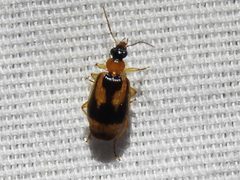
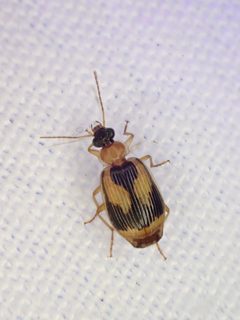
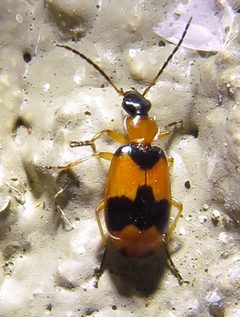
Pronunciation
How to pronounce Lebia: //ˈle.bi.a//
These audio files are automatically generated. While they are not always 100% accurate, they are a good starting point.
Identification
Distinguished from most other ground beetles by combination of flattened body form, frequent metallic coloration, and habitual presence on vegetation rather than ground surface. Separation from related Lebiinae requires examination of subtle characters including structure, elytral striation patterns, and male genitalia. Subgeneric assignment based on detailed morphological features not visible in field observations.
Images
Appearance
Small to medium-sized beetles with characteristically wide, flattened that give a low, streamlined profile. Coloration frequently iridescent or vividly metallic, ranging from bright green, blue, , to red or purple tones. Body form adapted for moving through vegetation rather than strictly ground-dwelling. and legs relatively long. Specific morphological features vary considerably across the 17 subgenera.
Habitat
Primarily associated with foliage and flowers of diverse plants; found in varied environments from forests to agricultural fields. Some linked to specific plants or . Ground-dwelling stages occur in soil, particularly for larval development.
Distribution
Worldwide distribution with recorded across multiple continents. Particular diversity in tropical and temperate regions. Individual species ranges vary from restricted endemics to widespread distributions.
Diet
are predatory on small insects. Some have been observed feeding on small insects generally; at least two species (L. grandis and L. subgrandis) specialize on Leptinotarsa leaf beetles. Larvae of some species are obligate of .
Host Associations
- Leptinotarsa decemlineata - and of L. grandis and L. subgrandis feed on and larvae; larvae parasitize
- Leptinotarsa juncta - and of L. grandis feed on and larvae; larvae parasitize ; presumptive original for L. grandis
- Leptinotarsa haldemani - and of L. grandis feed on and larvae; larvae parasitize
Life Cycle
are free-living . Larvae of at least some are obligate that develop within or pupae in soil. First-instar larvae actively seek hosts in soil substrate. occurs within host pupation site for parasitoid species. Adult lifespan 4-5 months in studied species.
Behavior
frequently observed on vegetation and flowers, actively moving among leaves and stems. At least some are primarily . Adults of studied species show escape when disturbed. Larvae lead cryptic existence in soil. At least two species (L. grandis, L. subgrandis) show narrow range with refusal of non-target prey even when starved.
Ecological Role
of small insects in vegetation . Some function as agents of agricultural pests, particularly Leptinotarsa leaf beetles including Colorado potato beetle. The combination of and larval provides 'double pest control' function in species where this is known.
Human Relevance
Potential and actual use as agents for Colorado potato beetle and related pests. Presence at lights indicates attraction to artificial illumination. Colorful appearance makes them noticeable to naturalists and photographers.
Similar Taxa
- Other Lebiinae generaSimilar flattened body form and vegetation-dwelling habits; distinguished by technical morphological characters
- Other metallic CarabidaeSimilar coloration but typically ground-dwelling with more convex body form; Lebia distinguished by flattened profile and foliage association
More Details
Parasitoid life history
Lebia is one of few carabid with larvae, and among very few parasitoid genera associated with feeding on living plants. This was first demonstrated in L. scapularis on elm leaf beetle. The trait appears to have evolved multiple times within the genus given its presence in distantly related .
Taxonomic diversity
With over 700 in 17 subgenera, Lebia represents one of the most species-rich in Carabidae. Subgenera include Chelonodema, Cymatographa, Glyciolebia, Grammica, Lamprias, Lebia (sensu stricto), Liopeza, Loxopeza, Metalebia, Nematopeza, Nipponolebia, Odontopeza, Poecilostola, Poecilothais, Polycheloma, Promecochila, Rhytidopeza, and Stephana.
Sources and further reading
- BugGuide
- Wikipedia
- iNaturalist taxon
- NCBI Taxonomy
- Catalogue of Life
- Bug Eric: New Mexico Night Bugs
- Bug Eric: Last Night to Blacklight?
- Biology of Lebia subgrandis Madge, A Natural Enemy of the Colorado Potato Beetle
- Prey preference and host suitability of the predatory and parasitoid carabid beetle, Lebia grandis, for several species of Leptinotarsa beetles