
Parvindela
Duran & Gough, 2019
American Diminutive Tiger Beetles, swift tiger beetle
Species Guides
6- Parvindela celeripes(Swift Tiger Beetle)
- Parvindela cursitans(Ant-like Tiger Beetle)
- Parvindela debilis(Grass-runner Tiger Beetle)
- Parvindela lemniscata
- Parvindela lunalonga(Meadow Tiger Beetle)
- Parvindela terricola(Variable Tiger Beetle)
Parvindela is a of small, flightless tiger beetles in the , established by Duran & Gough in 2019 when it was elevated from subgenus status within Cylindera. The genus contains adapted to specialized including loess hilltop prairies, sand plains, and gypsum mesas in the central United States. The type species, Parvindela celeripes (formerly Cylindera celeripes), is known from disjunct in northwestern Oklahoma and northwestern Missouri. These beetles are characterized by their diminutive size, rapid running speed, and reduced or absent wings.
Pronunciation
How to pronounce Parvindela: /ˌpɑr.vɪnˈdeɪ.lə/
These audio files are automatically generated. While they are not always 100% accurate, they are a good starting point.
Identification
Distinguished from similar small tiger beetles by the combination of: diminutive size (under 12 mm), flightless condition with reduced hindwings, elongated cylindrical body form, and specific associations (loess prairies, sand plains, gypsum outcrops). Separated from Cylindera sensu stricto by molecular and morphological characters supporting its elevation to status. The type P. celeripes can be identified by its small size, coppery-green coloration, and occurrence in loess hilltop prairie remnants. Distinguished from Ellipsoptera and other small tiger genera by body proportions and elytral maculation patterns.
Images
Appearance
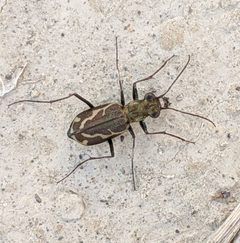
Small tiger beetles with elongated, cylindrical bodies typical of the 'Cylindera' morphological group. exhibit metallic coloration, often with green, bronze, or coppery reflections. The are marked with distinct patterns of maculations (pale spots or lines) that vary by . Hindwings are reduced or absent, rendering adults flightless. Legs are long and slender, adapted for rapid movement across open ground. are thread-like and moderately long. Overall body length is small relative to most tiger beetles, typically under 12 mm.
Habitat
Specialized open including loess hilltop prairies, sand plains, gypsum/red siltstone mesas, and sandstone escarpments. Associated with sparsely vegetated, erodible substrates on slopes and hilltops. In Oklahoma, found in pinyon-oak-juniper woodland on gypsum/siltstone mesas. In Missouri, restricted to small remnants of native loess hilltop prairie and adjacent altered pasturelands. Requires well-drained, exposed ground with minimal woody encroachment.
Distribution
Central United States, with confirmed records from northwestern Oklahoma (Major, Woodward, and Cimarron counties), northwestern Missouri (Atchison and Holt counties), and potentially adjacent Kansas. The appears to have a disjunct distribution reflecting the scattered occurrence of suitable loess and sand prairie across the Great Plains.
Seasonality
active from late May through early July, with peak activity in June. Activity is temperature-dependent, requiring warm sunny conditions. The earliest recorded observation is late May in Oklahoma; in Missouri, adults have been observed in mid-June.
Behavior
, fast-running that actively hunt small prey on open ground. Flightless, relying exclusively on running for locomotion and escape. are difficult to approach and photograph due to rapid movement and alertness. Activity ceases in cool, cloudy, or rainy conditions. Has been observed utilizing altered pastureland adjacent to native prairie remnants, suggesting some flexibility.
Ecological Role
of small soil-surface arthropods in open grassland and prairie . As a specialized inhabitant of erodible substrates, may serve as an for intact or recovering loess prairie and sand prairie . The flightless condition limits , making vulnerable to habitat fragmentation.
Human Relevance
Subject of conservation interest due to restricted distribution and specificity. The type P. celeripes is considered rare in Missouri, where it was first discovered in 2010. are threatened by woody encroachment, conversion of prairie to agriculture, and habitat fragmentation. Collected by entomologists for scientific study and personal collections; its discovery in altered habitats offers some hope for persistence in human-modified landscapes.
Similar Taxa
- CylinderaFormerly classified as subgenus within Cylindera; separated by molecular phylogenetic analysis and subtle morphological differences including genitalic characters and body proportions.
- EllipsopteraSimilar small size and open- preference; distinguished by winged condition in most , different body proportions, and elytral maculation patterns.
- CicindelaMuch larger containing many open- ; Parvindela species are smaller, flightless, and more specialized in substrate requirements than most Cicindela.
More Details
Taxonomic History
Originally described as Cylindera (Parvindela) by Duran & Gough in 2019, then elevated to full status. The taxonomic revision was based on molecular phylogenetic data and morphological analysis of the 'Cylindera' group.
Conservation Status
The type P. celeripes has an extremely restricted distribution in Missouri, known from only three small loess hilltop prairie remnants in Atchison and Holt counties. First discovered in the state in 2010. Oklahoma appear more robust but still localized.
Field Recognition
In the field, these beetles are most readily recognized by their small size, rapid running , and occurrence on specific substrates (loess, gypsum, sand). The flightless condition can be confirmed by the reduced hindwings visible when the are slightly lifted.