
Ellipsoptera nevadica knausii
(Leng, 1902)
Knaus's Tiger Beetle
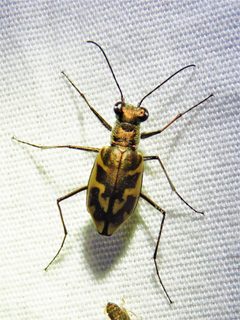
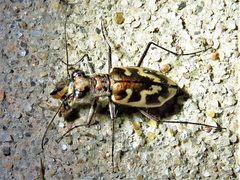
Ellipsoptera nevadica knausii is a of tiger in the Carabidae ( Cicindelinae). It is commonly known as Knaus's Tiger Beetle. The subspecies is distributed across North America, including Canada, the United States, and Mexico. Like other tiger beetles, it is a fast-running, visually oriented active in open .
Pronunciation
How to pronounce Ellipsoptera nevadica knausii: /ɛˌlɪpsəˈtɛrə nɪˈvædɪkə ˈnaʊzaɪ/
These audio files are automatically generated. While they are not always 100% accurate, they are a good starting point.
Identification
Distinguishing E. n. knausii from other of E. nevadica and from similar tiger beetles in the Ellipsoptera requires examination of elytral maculation patterns, body proportions, and geographic location. The specific diagnostic characters for this subspecies relative to nominate E. nevadica nevadica and other subspecies (e.g., E. n. macra, E. n. aureola) are not documented in the provided sources.
Images
Habitat
Observations indicate occurrence in saline or alkaline flat . A documented record from Salt Plains National Wildlife in Alfalfa County, Oklahoma, suggests association with salt flat environments.
Distribution
North America: Canada, United States, and Mexico. Specifically recorded from northwestern Oklahoma (Alfalfa County) and more broadly across the central and western United States.
Seasonality
have been observed in June in Oklahoma. Activity patterns likely follow typical tiger seasonality, with adult timed to warm conditions in spring through summer.
Behavior
Males clamp onto females with their during mating, extending the outward to the sides and footing the meso- and metalegs onto the substrate. This posture renders mating pairs less -responsive and easier to approach than solitary individuals.
Similar Taxa
- Ellipsoptera nevadica nevadicaNominate ; distinguished by elytral pattern and geographic range, though specific differences for knausii not detailed in sources.
- Other Ellipsoptera species-level similarity in body form and preference; and identification requires careful examination of maculation and genitalia.
More Details
Mating behavior observation
Mating posture in this follows the pattern observed in other tiger beetles: male mandibular clamping with extended laterally rather than grasping the female. This contrasts with mating postures in Eleodes suturalis (Tenebrionidae) and Chrysobothris ignicollis (Buprestidae), where males use legs to clamp females.
Taxonomic note
Some sources list as , reflecting historical treatment of tiger beetles as a separate family. Current classification places Cicindelinae as a within Carabidae.